Sunnyvale Civic Center Community Plaza and Open Space
Honor Award /
2026, Urban Design
Sunnyvale, CA

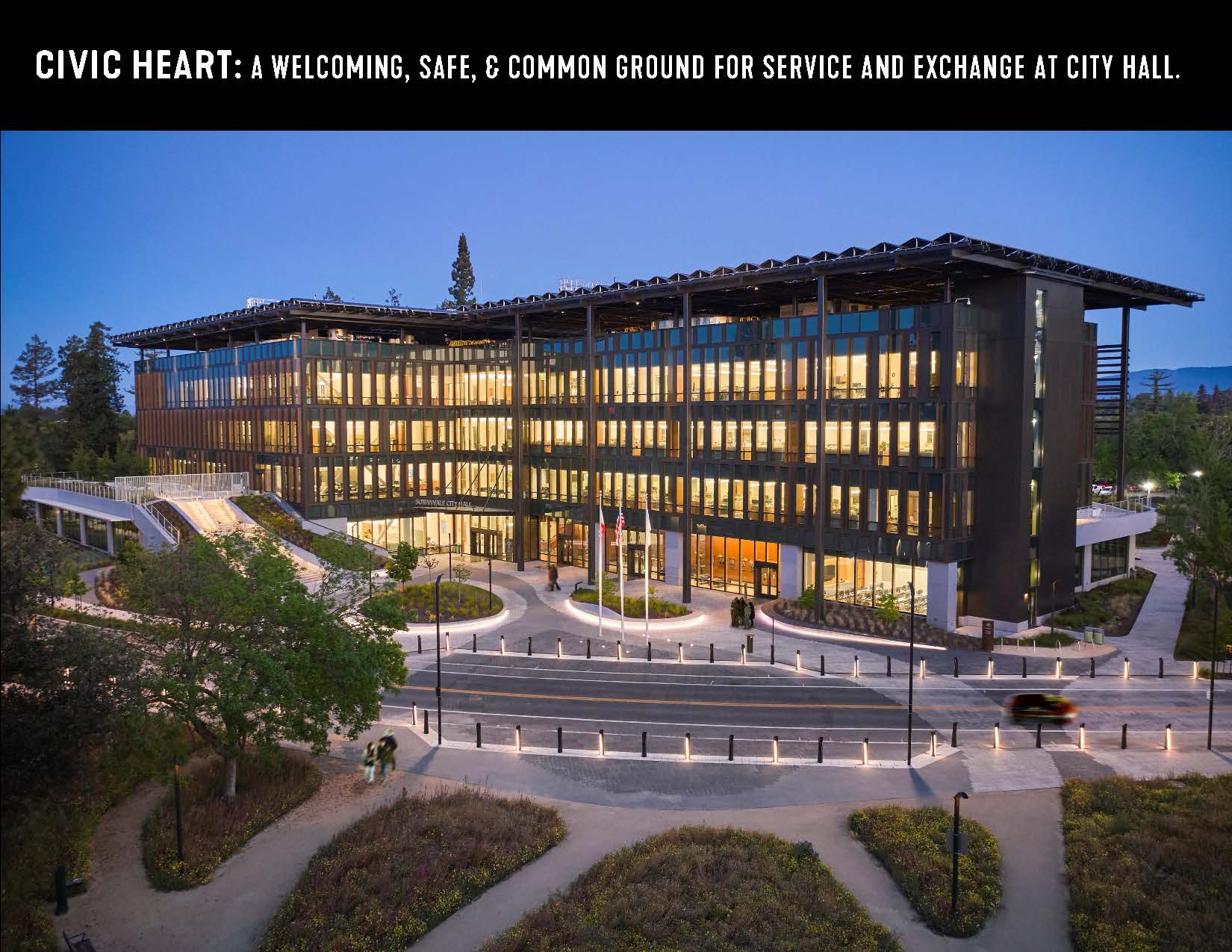
District framework prioritizes safe walk/bike/bus access, stitching neighborhoods to City Hall, Library, and Public Safety via shaded corridors and plazas. The 20 year phased plan expands tree canopy, stormwater capacity, and inclusive civic spaces that welcome all ages, abilities, and cultures.
© OSmithGroup

A paradigm shift: Sunnyvale Civic Center transforms a 24-acre car-dominated site into a vibrant, open, and accessible sustainable hub. Prioritizing community health and environmental stewardship, it integrates diverse program elements with native landscapes, becoming a beacon of resilient urban development.
© OSmithGroup

A central plaza links the city hall and the future phased buildings, creating a walkable civic core. A flexible street, closed during programmed events, fosters community engagement. Integrated native plantings enhance biodiversity and ecological resilience within this vibrant, adaptable space.
© Anthony Lindsey Photography
Olive Avenue’s redesign removes parallel parking, adds passenger drop-offs, and prioritizes pedestrian and cyclist safety with protected, tree-lined sidewalks and bike lanes. Traffic calming, flush walkways, and lighting enhances the vibrant, democratic plaza while integrating native planting along the street.
© Anthony Lindsey Photography

The south democratic plaza, framed by an educational bioswale and native landform, conceals parking. Saved redwoods shade the building, enhancing energy efficiency. Sinuous paving and benches guide users and provide respite; the second-floor sky garden offers city staff outdoor workspace.
© Anthony Lindsey Photography

Community priorities drove canopy preservation: fourteen mature trees were relocated two camphors now frame the civic gateway—maintaining the campus’s park like microclimate, strengthening habitat continuity, and demonstrating low carbon, construction phase stewardship integral to an equitable, resilient urban design.
© OSmithGroup/Todd Kohli

The democratic plaza creates a unified civic core where gatherings, announcements, and everyday interactions occur. Its flush, universally accessible surface links future library and public safety buildings within a one minute walk, transforming a once disconnected campus into an equitable, inclusive urban commons.
© OSmithGroup/Todd Kohli

When the street closes, fairs activate the civic campus, integrating local commerce with shaded routes, and accessible open space. The plaza’s design supports equitable gathering, fostering cultural exchange and public life while embedding biodiversity and resilience into the everyday.
© OSunnyvale

Root inspired paving blends open flow: darker bands guide, lighter courts invite respite. High SRI granite and shade reduce heat, supporting LEED Platinum certification. Parametric design/layout doubles as signage; locally sourced California granite, CNC milled within 160 miles, ensures durable, low carbon longevity.
© O Coldspring/Dante Dugan

Set within a preserved redwood grove, the amphitheater creates an inclusive civic room for learning, performances, and community gathering. Its terraced form links ecology with culture expanding access to outdoor education-strengthening the civic campus as a shared public realm.
© Anthony Lindsey Photography

Level two public sky garden is linked to the grand stair and one stop permit center. Native planting, shade, and calibrated wind/sun exposure create comfortable microclimates. Integrated power and Wi Fi with GFRC benches extend outdoor work, conversation, and respite above the plaza.
© Anthony Lindsey Photography

The south terrace extends civic work into the landscape, using PV supported shade, filtered light, and calibrated microclimates to create equitable outdoor workspace. Overlooking the south plaza, it strengthens vertical connections between public services, daily work, and the broader civic campus.
© Anthony Lindsey Photography

Interpretive graphics make climate strategies visible, showing how redwood cooled microclimates, shading, and building performance work together. By revealing hydrology, comfort, and energy logic to the public, the civic campus advances equity through accessible environmental learning embedded in the urban realm.
© OSmithGroup & Sunnyvale

Water smart urbanism made legible: bioretention basins, infiltration chambers, and graded walks slow, filter, and sink runoff to meet C3. Interpretive graphics explain flow paths and performance, turning stormwater infrastructure into public learning and equitable, climate resilient urban design.
© OSmithGroup & Sunnyvale

An open civic landscape where routes from neighborhood and transit flow through habitat to City Hall. Markets, rallies, and daily services share ground-advancing equity, climate resilience, and belonging as an everyday urban experience.
© OSunnyvale
Client
City of Sunnyvale
Project Team
Todd Kohli, Lead Landscape Architect, SmithGroup
Meghan Storm, Landscape Architect, SmithGroup
Toni Candanedo, Landscape Designer, SmithGroup
Tingyuan Luo, Landscape Architect, SmithGroup
Project Statement
The Sunnyvale Civic Center transforms an auto-oriented campus as a people-first center of public life. Two interlinked plazas north and south of City Hall connect public trails, sky gardens, pollinator meadows, and amphitheater. Over six acres of reclaimed open space and 40,000 SF of civic plaza reverse past land-use patterns while improving access.
A climate-forward landscape restores 60% of the site with regenerated soils and 100% native/adapted vegetation, achieving an 82% outdoor-water reduction far exceeding requirements. A tree preservation effort relocated 14 mature trees and expanded the canopy with 225 new trees.
Low-carbon strategies include CNC-fabricated granite benches milled locally and optimized concrete mixes. Power, shade, Wi-Fi, and calibrated microclimates extend civic work, study, and assembly outdoors.
The landscape supports a LEED Platinum civic building and a registered Net-Zero Energy solution -the first in the US–delivering a resilient, equitable landscape that centers people and culture in Silicon Valley.
Project Description
A Civic Heart for All
Phase 1 establishes a people-first center of civic life with two interlinked plazas–north and south of City Hall-stitched to trails that weave through mature tree groves, pollinator gardens, a tree-lined streetscape with Class II bike lanes and no street parking, and a community amphitheater. The plazas operate as a democratic commons: an everyday living room for families, students, and neighbors; an extraordinary stage for assembly, protest, celebration, and ceremony. Their figure-ground reads with clarity: dark connective paths deliver movement and procession; lighter courts offer rooms for pause, exchange, and civic ritual—an urban language that orients, welcomes, and belongs to everyone.
Public Realm Reclaimed
Where surface lots and dispersed buildings once dominated, the plan flips the ratio: 6 acres of new open space, 40,000 SF of civic plaza, connected walking loops, and a learning-rich amphitheater embedded in an existing redwood grove. The sequence extends along streets and campus edges, improving walkability and bikeability and strengthening links to the city’s bike master plan, transit hubs, and adjacent neighborhoods reflecting a network that prioritizes people over cars.
Community Led and Legible
A multi-year engagement process elevated community priorities-trees, trails, gardens, art, plaza space which directly shaped the outdoor program: interpretive paths, an amphitheater for civic learning and performance, and plaza rooms scaled for markets, rallies, and cultural events. The result is a readable public-realm framework that sets a replicable pattern for future phases.
Climate Forward Urban Landscape
The landscape restores 60% of the site with native and adapted vegetation-minimizing maintenance while enhancing habitat for local fauna and pollinators-over rebuilt soils, achieving an 82% reduction in outdoor water use. On-site treatment exceeds stormwater performance through visible, didactic bioswales that double as wayfinding and environmental instruction. Microclimate modeling calibrated shade, orientation, and wind exposure; power and Wi-Fi extend civic life outdoors for meetings, study, and remote work throughout the day.
Biodiversity, Resilience, and Care
Canopy protection and succession are central. Fourteen mature trees were carefully transplanted while 225 new trees expand shade, carbon drawdown, and habitat. A northern pollinator garden reuses excavation spoils to form berms seeded with native wildflowers, and oak woodland, redwood, and California grassland communities are recomposed as a campus-scale, successional mosaic for birds and pollinators. Night-sky–sensitive lighting preserves nocturnal ecologies and visual comfort. The expanded open space yields inclusive environments for all ages and abilities, promoting daily health and well-being.
Material Precision, Lower Carbon
The civic room’s tectonics are deliberate: locally CNC-fabricated granite bench-walls and paving- 222 radial modules, each 3 feet long-were milled on 5-axis equipment within 160 miles of the project site. Regional fabrication was made possible through the landscape architect’s long-standing collaboration with the stone manufacturer. The design team worked closely with the manufacturer to develop a California facility, enabling fabrication within the region. This major shift in operations eliminated out-of-state transport, reducing emissions while tightening tolerances, accelerating prototyping and mock-ups, and producing durable, finely milled urban furniture with a timeless finish all manufactured in California. Optimized concrete admixtures further lower embodied carbon, aligning material craft with climate goals while seeding new regional capacity for advanced stonework.
A Landscape that Teaches
Wayfinding and interpretive elements–species markers, bioswale sections, plaza-edge displays— turn everyday trips to City Hall and the Library into environmental literacy about trees, soils, water, and climate. Trails and sky gardens deliver biophilic exposure and restorative microclimates, while power–enabled seating supports outdoor governance, collaboration, and study.
Urban Design Outcomes
- Access & Legibility: universal, barrier–free edges; seating, shade, and water within a two-minute radius; clear sightlines and program legibility.
Mobility & Connectivity: continuous walking loops; protected bike connections to the wider network; strengthened multimodal links that reduce car dependence.
- Health & Well-Being: an outdoor workplace supported by microclimate comfort, Wi-Fi, and power; restorative gardens and sky terraces.
- Performance & Stewardship: native habitat, soil rebuilding, on-site stormwater education, and community programming that sustains use over time.
High Performance Civic Campus
Phase 1 supports a LEED Platinum-certified civic building and Net Zero Energy registered- evidence that municipal infrastructure can lead on climate, equity, and design. By making democratic space the organizing principle-and aligning craft, ecology, and mobility—the project reframes civic landscape as everyday culture, both destination and foundation for a more resilient, inclusive city.