
TikTok Xiamen: Reframing Corporate Campus as Civic Infrastructure
Merit Award /
2026, Urban Design
Xiamen, China

Music Wave Boulevard forms a central urban valley, transforming a corporate campus into a layered civic landscape of terraces, gardens, and performance spaces.
© Zongyi Su

Campus clearing within a subtropical urban forest buffers density while framing social space at the heart of the development.
© Yi Zhu

Master plan illustrating the Music Wave Boulevard, Valley, plazas, gardens, and mixed-use program woven into the surrounding city grid.
© Yi Zhu

Layered boundaries dissolve edges between hotel, office, retail, and municipal streets, creating a porous urban interface.
© Xu Zhong

Diagram of Music Wave Boulevard and Valley showing stacked uses, terraces, amphitheater, and vertical landscape integration.
© Yi Zhu
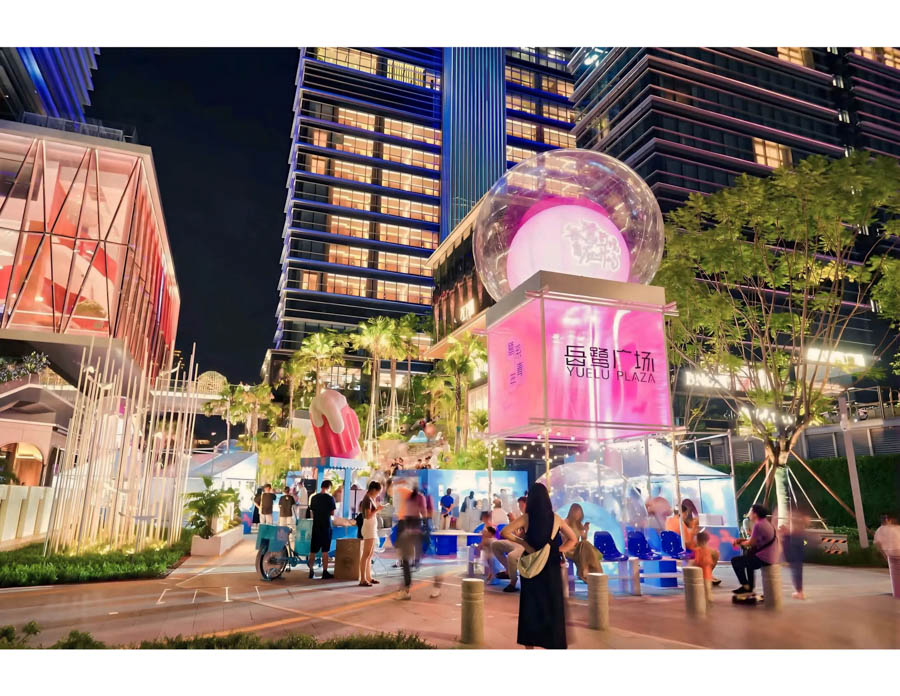
Rhythmic Plaza activates the urban edge with interactive fountains and event infrastructure, extending public life into the campus.
© Zongyi Su

Evening programming transforms the plaza into a civic gathering space for festivals and informal social interaction.
© Zongyi Su

Vertical gardens and escalator corridors create immersive arrival sequences within a high- density mixed-use complex.
© Zongyi Su
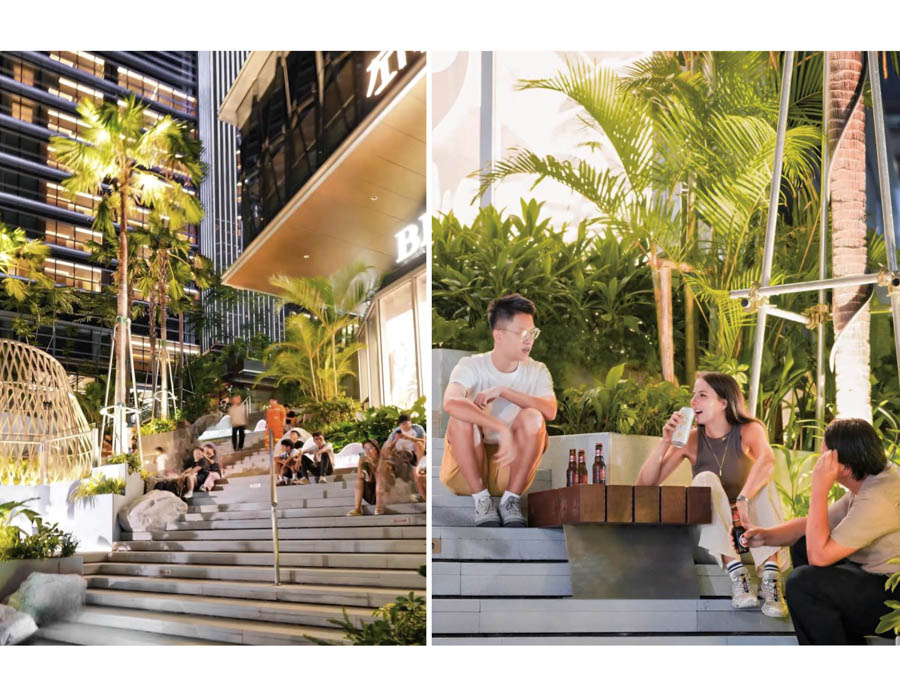
Amphitheater steps double as circulation and social space, cascading from dining terraces to a recessed movie court below.
© Zongyi Su
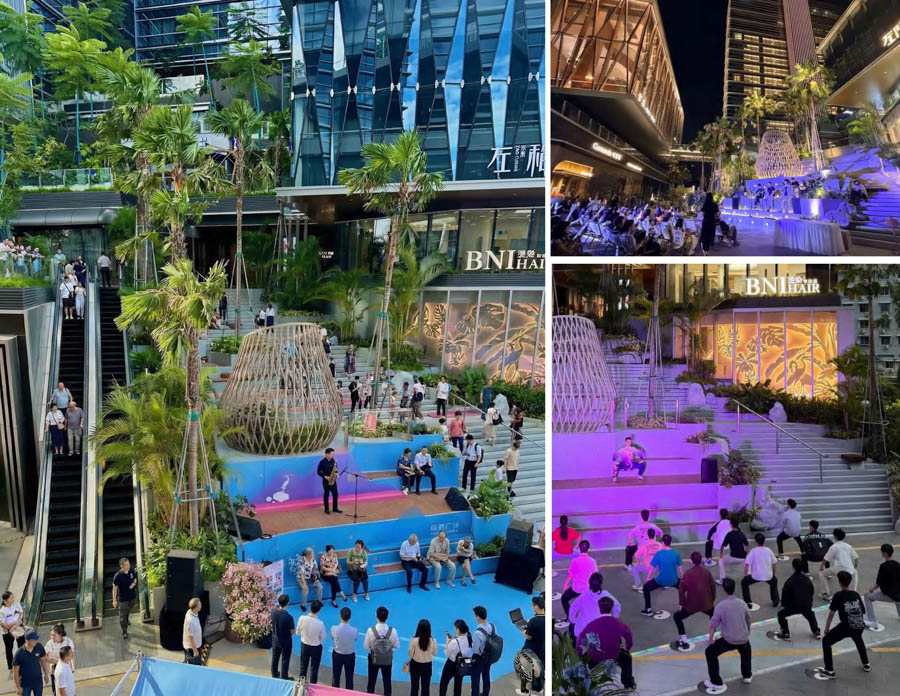
Flexible performance spaces support daily gathering and large–scale events, reinforcing the campus as cultural infrastructure.
© Zongyi Su

Coastal gardens with native subtropical planting reinforce Xiamen’s identity as a “Sea Garden.”
© Xu Zhong

Music Wave Valley integrates dining, terraces, and forested gardens into a multi-level urban room.
© Xu Zhong

A landscaped transition zone mediates between municipal street and campus, reducing conflicts and creating shared civic space.
© Xu Zhong

Street–corner gardens provide shaded micro-spaces for informal meetings, strengthening the campus–city interface.
© Xu Zhong
Client
ByteDance
Project Team
Yi Zhu, Lead Landscape Architect
Project Statement
The Tik Tok Xiamen transforms a high-density mixed-use campus into an urban cultural landscape. Inspired by Xiamen’s identity as a “garden on the sea” and the company’s music-driven digital platform, the project introduces a continuous Music Wave Boulevard and Valley that stitches together offices, hotel, residences, retail, and the public realm. Rather than operating as a privatized corporate enclave, the campus functions as urban infrastructure – extending open space into the surrounding streets and forming a layered sequence of plazas, terraces, amphitheaters, and gardens accessible throughout the day and evening. Vertical landscapes, shaded forest clearings, and programmable civic spaces blur the boundary between development and city. The project demonstrates how a corporate headquarters can catalyze public life, reinforce ecological identity, and contribute meaningfully to the urban district.
Project Description
Xiamen, known as China’s “Sea Garden,” is defined by subtropical climate, coastal ecology, and a vibrant music culture. Located at Binbei Super Headquarters Base – planned as a flagship economic district – the Tik Tok Xiamen occupies a prominent urban gateway connecting the Cultural Arts Center, Sports Center, and surrounding neighborhoods.
The project reframes the corporate campus as a civic landscape embedded within the city. Rather than isolating office functions, the design establishes a continuous public spine – the Music Wave Boulevard – running between two major building volumes. This boulevard descends into the Music Wave Valley, a sectional urban room that integrates amphitheaters, dining terraces, performance stages, recessed courts, and shaded forest gardens.
The spatial concept operates as an “urban clearing within a forest.” A contemporary subtropical canopy buffers the development while framing central social spaces. Native coastal planting, layered vertical gardens, and shaded pedestrian corridors mitigate heat, enhance biodiversity, and reinforce Xiamen’s ecological identity.
At ground level, a Rhythmic Plaza dissolves rigid site boundaries and welcomes public movement from the city grid into the campus interior. Motion-activated fountains, programmable lighting, and event infrastructure support informal gathering and festivals. This plaza serves not as an entry forecourt but as an extension of the city’s public realm.
The project’s most distinctive move is sectional activation. Rather than concentrating activity at grade, terraces cascade from rooftops to street level and down to a recessed Movie Court equipped with a large digital screen. Parallel circulation systems – including escalators and amphitheater steps – create alternative vertical pathways, transforming circulation into social space. This multi-level choreography increases visibility, engagement, and inclusivity within a dense urban footprint.
Edges are treated as gradients rather than boundaries. Along municipal streets, a landscaped transition zone reduces conflicts between pedestrians, cyclists, and vehicles while generating shared public forecourts. These zones soften the distinction between corporate property and civic space, offering seating, gardens, and shaded rest areas accessible to the broader community.
Programmatically, the campus integrates offices, hotel, residences for creative professionals, and street-level retail. This stacked mix of uses ensures activity throughout the day and into the evening, reinforcing economic vitality and safety. Music-themed gardens, restaurants, and event venues embody the cultural identity of both the company and the city, transforming brand narrative into spatial experience.
Sustainability is embedded in the project’s urban strategy. Dense planting reduces urban heat gain, improves microclimate, and supports stormwater infiltration. Vertical gardens increase green surface area within limited footprint. Permeable paving and layered soil systems enhance water management. The subtropical plant palette emphasizes native and climate-adapted species to reduce irrigation demand and long-term maintenance.
By merging ecological infrastructure, civic programming, and corporate development, the project demonstrates how high-density headquarters can contribute to broader urban systems. It offers a replicable model for integrating public life, environmental performance, and economic innovation within rapidly urbanizing coastal districts.

