
Iron Horse Trail Overcrossing at Bollinger Canyon Road
Merit Award /
2026, Urban Design
San Ramon, CA

The over crossing bridge and approach frame views of the borrowed landscape of the San Ramon Valley.
© Marion Brenner

Trees line both sides of the planted approaches to the overcrossing, drawing inspiration from agricultural history of the San Ramon Valley.
© (L) Marion Brenner/ (R) archival postcard

The landscape’s rows of flowering trees recall the orchard landscapes of the region.
© Marion Brenner

Located off the main trail, rest areas with fixed benches offer space to gather and take in views of the surrounding regional wilderness.
© Marion Brenner
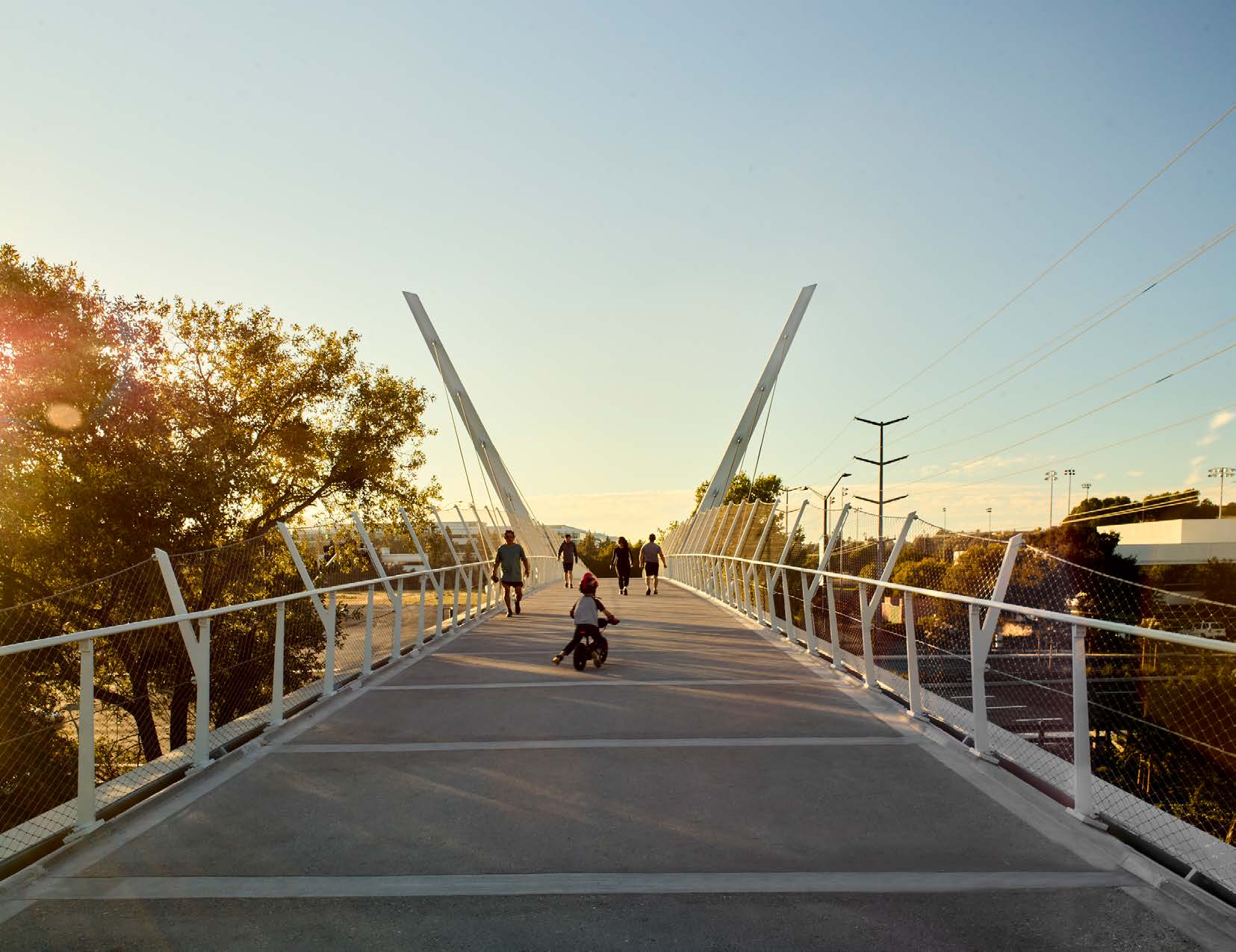
The project consists of a new 340-foot cable-stayed bridge with landscape approaches as a dedicated, accessible overcrossing for trail users.
© Marion Brenner

Seating nodes on either side of Bollinger Canyon Road draw upon a railroad vernacular.
© Marion Brenner

The Iron Horse Trail follows the Southern Pacific Railroad right of way established in 1891.
© (Above) archival documents / (Below) Marion Brenner

Introducing a rich native planting palette supports the regional ecosystem, creating habitat and improving biodiversity.
© Marion Brenner

The over crossing is a streamlined continuation of the regional multi-modal recreational trail.
© Marion Brenner
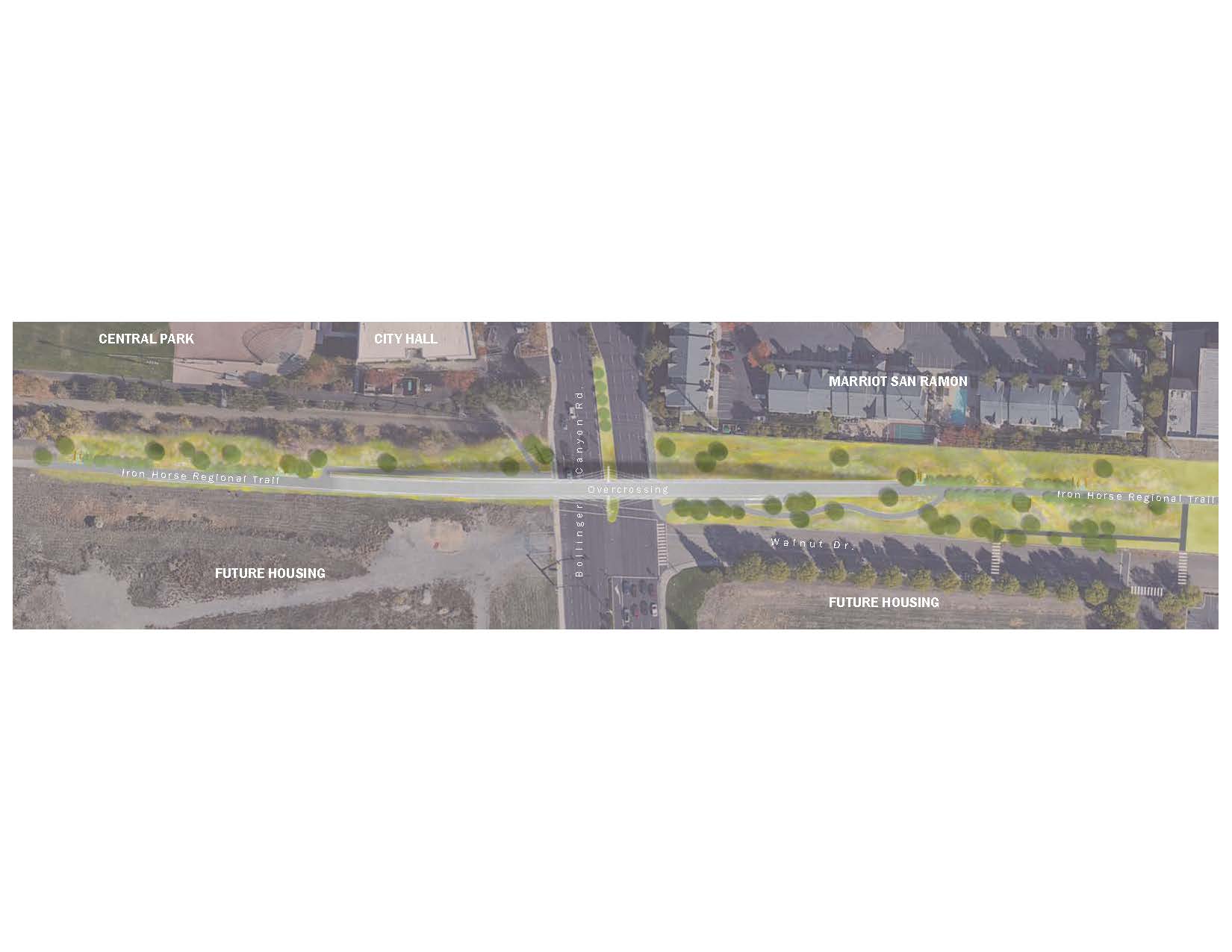
The over crossing project boundaries extend over 2 acres across Bollinger Canyon Road in the heart of San Ramon.
© Surfacedesign, Inc.
Client
City of San Ramon
Project Team
Lead Landscape Architect: Roderick Wyllie, Tim Kirby, Vanessa Nuñez
Matt Baughman, Associate Project Director
Ryan Woodward, Bridge Design Lead
Project Statement
Situated along the 30+ mile Iron Horse Regional Trail, the Bollinger Canyon Road Overcrossing represents a transformative investment in San Ramon’s social and environmental infrastructure, introducing non-motorized circulation, community activation, and placemaking through a landscape-driven design that addresses urban design challenges and mobility complexities in the East Bay suburb.
This visually compelling urban intervention transforms a post-industrial site with a historic agricultural legacy, integrating a 340-foot cable-stayed bridge into a linear park that engages pedestrians, cyclists, and daily commuters. The project creates a fluid, multi-modal trail ecosystem that is accessible for all, prioritizing non-motorized transportation while offering an uninterrupted, vibrant trail experience.
Nestled between City Hall, residential neighborhoods, and the renowned commercial center of Bishop Ranch, the 2.5-acre Overcrossing establishes a new model for public open space—one that strengthens social connections, promotes physical activity and well-being, prioritizes safety and accessibility, and celebrates the surrounding California ecology.
Project Description
The Bollinger Canyon Road Overcrossing transforms San Ramon’s urban landscape, advancing social and health infrastructure by linking parks, schools, civic institutions, and employment centers along a 30-mile active transportation corridor.
Following the 2009 San Ramon Valley Bicycle Pedestrian Corridor Concept Plan and where the Southern Pacific Railroad right-of-way and trail had previously been interrupted by a eight-lane roadway, the landscape designers—as part of the engineer-led team–created a 340-foot cable- stayed bridge and linear park provides a dedicated, accessible crossing over the city’s highest- volume arterial roadway at Bollinger Canyon Road, enhancing safety and continuity for pedestrians, cyclists, and daily commuters while reinterpreting the region’s industrial heritage and agricultural legacy through uniquely landscape-forward and urban mobility design moves.
Situated along the Iron Horse Regional Trail, a former Southern Pacific Railroad corridor right-of- way established in 1891 – the corridor was originally built to haul crops, cattle, and raw materials through the San Ramon Valley during the region’s agricultural heyday. Abandoned in 1978, the corridor has been transformed into a beloved multi-use trail connecting Pleasanton to Concord and links neighborhoods, civic spaces, and commercial centers while celebrating the San Ramon Valley’s rolling topography, oak savanna ecology, and agricultural history.
Inspired by the San Ramon Valley and surrounding wilderness, the design harnesses multi-modal pathways and accessible connections to seamlessly integrate existing trail networks with defined plantings and curated points of interest to enhance the city’s urban design framework. Lining the bridge, rows of flowering trees reference the area’s historic orchards, while seating nodes become a nod to the railroad vernacular and are complemented by rocky outcroppings that echo the geology of nearby Las Trampas Regional Preserve, reinforcing a sense of place. Gentle bucolic landscaped embankments receive the bridge while native, drought-tolerant plantings support biodiversity and attract pollinators. Permeable-surfaced seating nodes positioned off the main path offer visitors a place to rest and take in the views of the surrounding hills.
The design team’s commitment to sustainability and ecological resilience informed the material selection and technical aspects of construction. Inventory and analysis of existing trees were conducted to assess their health. As a result, groupings of mature oak trees and vegetation in low lying areas were retained, maintaining tree canopy cover for user comfort. Site soils were stockpiled for reuse, and an extensive number of native and low water use plants were incorporated into the landscape design, enhancing visual quality and creating a more welcoming, shaded public realm that supports walking, biking, and community gathering. Locally sourced moss rock boulders were used to accent seating areas, recalling the rock formations surrounding San Ramon.
By engineering the bridge and its multi-modal path through design and landscape, the Overcrossing transforms daily commuting into a civic experience with the landscape being a cohesive element that strengthens the public realm while enhancing the region’s urban design network; linking residential neighborhoods to recreation fields, schools, San Ramon City Hall, and commercial centers, the design enables a safe, accessible trail that fosters social connections, encourages physical activity, and provides equitable access to nature across the region.
As a result, the new Overcrossing has become a landmark that welcomes visitors to San Ramon, complementing the architecture of nearby City Center Bishop Ranch. At the heart of where life unfolds in the city—a place to live, work, and play-the Overcrossing serves both metaphorically and literally as a pathway to connection: linking the local community to one another and to the surrounding California landscape. It stands as a successful example of cohesive, collaborative design, demonstrating the power of interdisciplinary coordination across multiple public agencies.
Bollinger Canyon Road exemplifies landscape-forward urban design and mobility, reinterpreting the region’s railroad industrial heritage and agricultural legacy through a 21st-century lens, prioritizing pedestrians and cyclists while seamlessly weaving convenience, lifestyle, and ecological sensitivity into daily life-creating a civic landscape that actively nurtures health, connection, and well-being.

