
Set on a raised plinth above meadow, Kusama’s Infinity Room reflects olive trees and the surrounding landscape.
© Marion Brenner

Site plan illustrating vineyard context, creek restoration, native hedgerows, orchards, and integrated landscape systems.
© Erin Feinblatt

Detailed plan of the landscape surrounding the main residence and associated garden rooms.
© Matt Morris

Section showing creek restoration, vineyard slopes, and hedgerow planting near the barn.
© Bob Stefko

Relocated driveway allows native planting to restore riparian habitat within the salmon creek setback.

A concealed pedestrian walk through grasses screens the residence from the entry drive.

Rows of olive hedges separate vineyard and residence, with mature olives providing shade at the upper terrace.

A shaded trellis frames views from the residence toward the vineyard beyond.
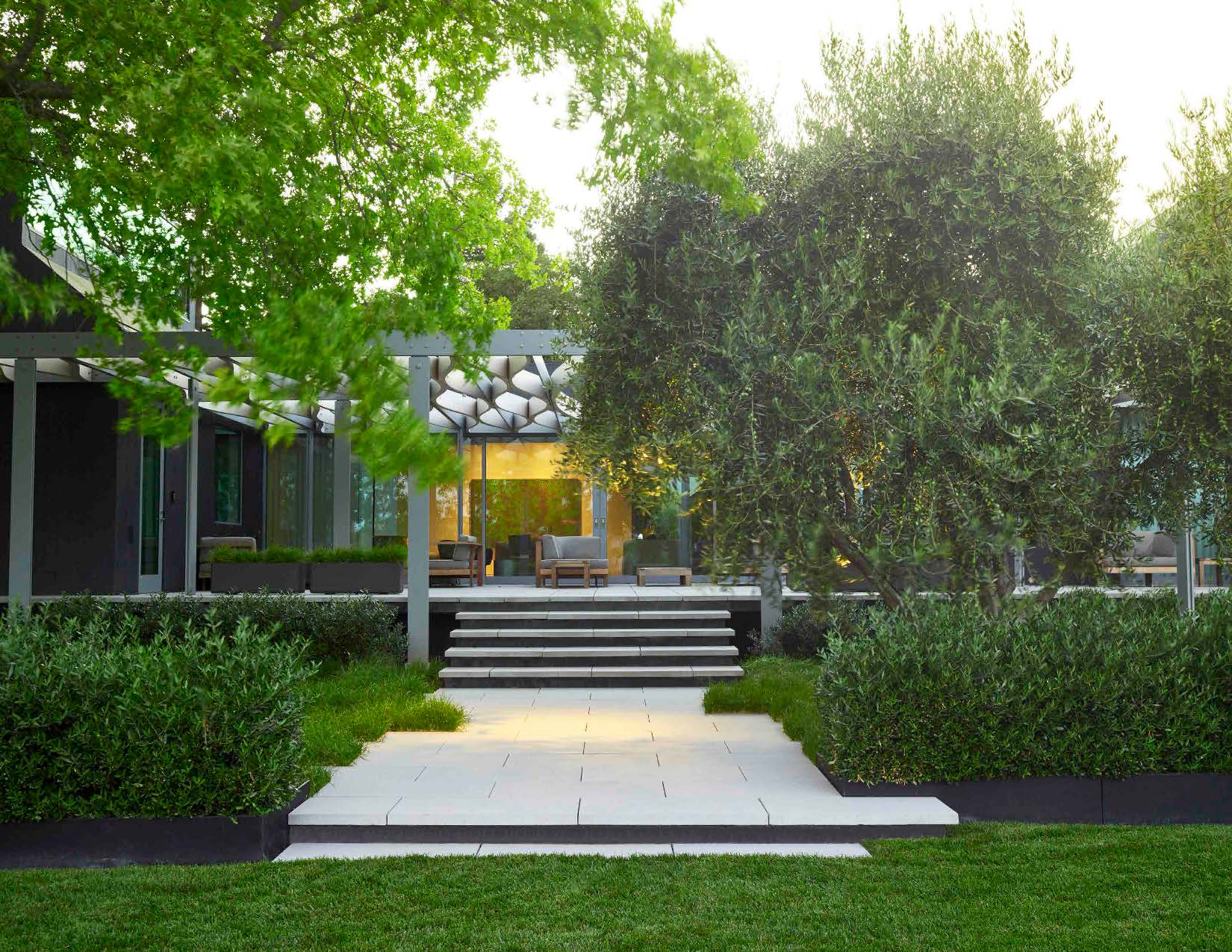
An elevated deck extends living space outward, creating expansive views across the valley floor.

Gravel and reclaimed granite define the entry, with production olives guiding arrival toward the meditation labyrinth.

Seasonal vineyard views are framed by a Robert Irwin sculpture reflected in a shallow pool.
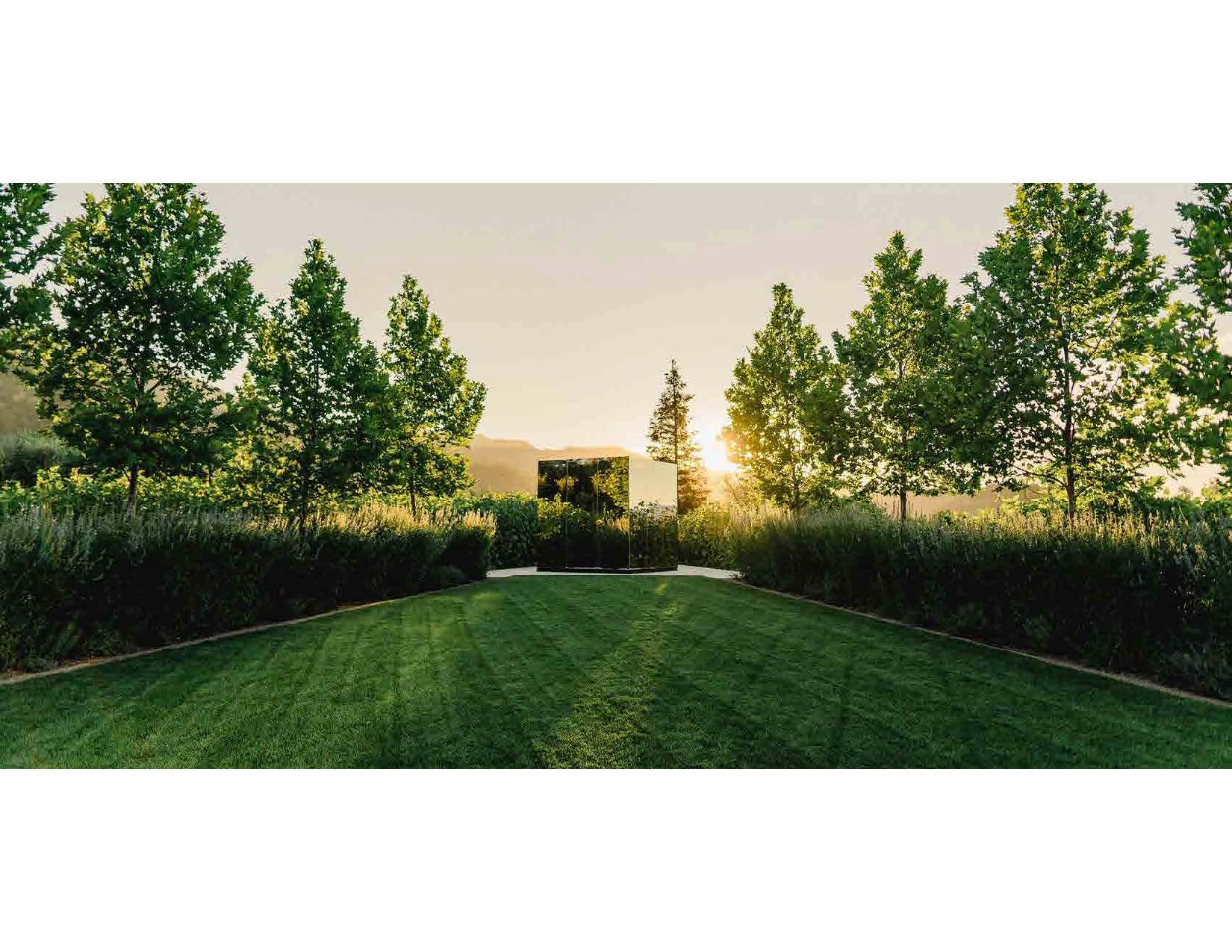
A rising lawn inspired by Palazzo Spada leads to Kusama’s Infinity Room, creating a deliberate visual illusion.
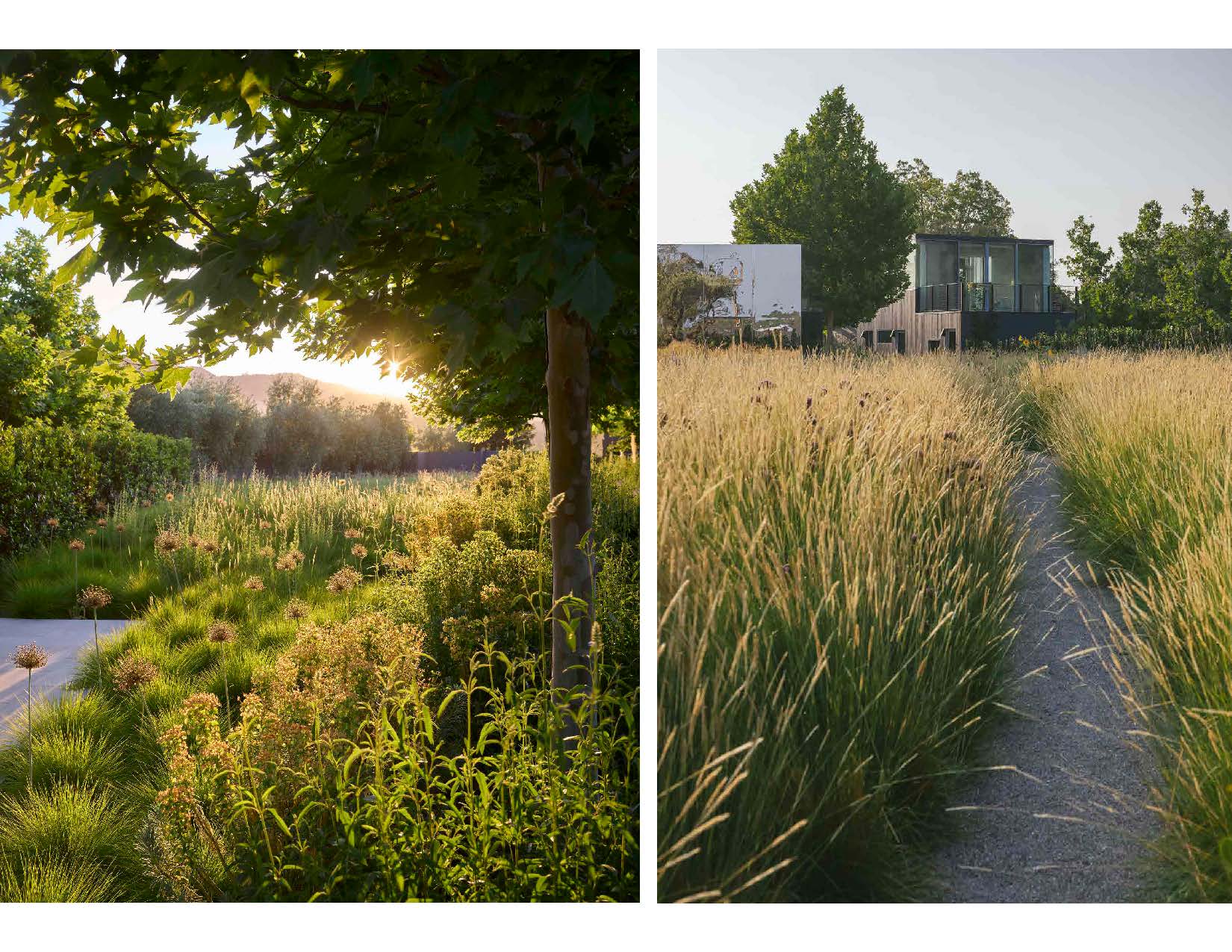
Meadow paths surround the raised plinth, offering changing seasonal views and immersion in landscape.

A secluded meditation labyrinth of reclaimed cobble set within an existing olive grove is now the winery’s symbol.
Client
N/A
Project Team
Sarah Keizer, Lead Landscape Architect
Andrea Cochran
Judith Yang
Horngsheng Tu
Project Statement
Over twelve years, our office partnered with the client to transform a historic Napa Valley vineyard on the Rutherford Bench-Napa’s first distinct terroir-into an organic and biodynamic model of land stewardship. Guided by the client’s background in historic preservation, the project evolved incrementally, honoring the site’s agricultural legacy while advancing ecological resilience. A roadside creek was restored, native habitats rebuilt, and hedgerows and orchards established to support biodiversity and soil health. Integrated artworks from the client’s collection are woven throughout the landscape, reinforcing a dialogue between culture, agriculture, and place.
Project Description
Located between the Napa Valley floor and the Mayacamas Mountains, this 20-acre project transforms Bella Oaks—one of Napa Valley’s earliest single-vineyard estates—into a living model of stewardship, ecological resilience, and contemporary landscape design. Founded in the mid-20th century by Belle and Barney Rhodes, Bella Oaks played a formative role in establishing Napa Valley’s culinary and agricultural heritage.
Drawing on her experience as a conservator and art collector, the client partnered with our office to shift the landscape from extraction toward restoration and long-term stewardship, aligned with the vineyard’s organic replanting. The project began with modest interventions around the main residence and expanded over time as the client’s commitment to land stewardship deepened.
Early efforts focused on relocating the existing entry drive out of a designated blue-line salmon creek setback and restoring the native riparian corridor to encourage habitat recovery. This work set the foundation for a broader ecological strategy that includes biodiverse hedgerows, orchards, and meadows designed to support pollinators, improve soil health, and increase populations of beneficial insects. The design program encompasses the main residence, creek restoration, meditation labyrinth, vegetable gardens, barn, meadow systems, art installations, olive orchard, and native hedgerows each integrating functional, ecological, and experiential goals.
The landscape employs a linear spatial language that echoes the architecture, organizing outdoor spaces into a sequence of connected garden rooms. Rows of dwarf olives, mature olive and oak trees, and terraced meadows create layered experiences while framing expansive views across vineyards and hillsides. Lower pathways wind through meadow grasses, olive hedges, sunken bocce courts, and lawn areas. Circulation, thresholds, and sightlines are carefully choreographed to encourage exploration, seasonal awareness, and engagement with the broader site, while the client’s sculpture collection establishes focal points throughout the landscape.
Two artistically driven landscapes further enrich the estate. The first is a sloped courtyard inspired by Borromini’s forced perspective at the Palazzo Spada in Rome. A rising lawn and narrowing geometry create a visual illusion as one approaches Kusama’s Infinity Room, set on a raised plinth that mirrors the cantilevered deck of the residence and connects visually to the valley floor. The second is a meditation labyrinth edged with reclaimed cobbles and nestled beneath existing Sevillano olive trees. Referencing the medieval Chartres labyrinth, it provides a place for reflection and has become a symbolic identity for the winery.
Through long-term collaboration, Bella Oaks has been revitalized as a biodiverse, culturally enriched estate where history, agriculture, and design converge. By integrating vineyard productivity, ecological restoration, and experiential landscapes, the project establishes a precedent for agricultural residential design rooted in stewardship and continuity.