

Aerial perspective of Blue Oak Landing. Supportive affordable housing is organized around a sequence of outdoor rooms, such as garden, play, dog run, and gathering; transforming a constrained parcel into a layered landscape system.
© Bruce Damonte

Plan of Blue Oak Landing. Linked by open-air circulation, the building siting harnesses wind patterns to create natural ventilation while framing views from the breezeway out across the courtyard landscape towards Austin Creek beyond.
© Fletcher Studio

Building elevation along Sacramento Street. The project redefines supportive housing along a major Vallejo corridor, pairing durable materials with landscape buffering to create dignity, shade, and pedestrian-scaled frontage within a high-traffic urban context.
© Bruce Damonte

Pathway leading towards the front entry to the 75 supportive affordable apartments, serving families, couples, and individuals experiencing homelessness or who are at risk of homelessness.
© Bruce Damonte

Front entry approach featuring a California native plant palette, selected to reduce long-term irrigation demand and support urban wildlife, such as pollinators. Distinct custom perforated weathering-steel panels welcome residents and visitors to the Blue Oak Landing community.
© Barry Schwartz

The open, visible entry is anchored by a stand of Blue Oak trees, working together with the custom Oak ceiling sculpture designed by the Architect, in a nod to the Blue Oak Landing community branding.
© Bruce Damonte

Looking down the hallway towards the front entry. A flexible space anchors circulation and gathering, balancing open play with tree canopy and seating.
© Bruce Damonte

Paths flanked by planting and reclaimed timber benches lead residents from the main entry, anchored by a custom architectural Oak ceiling sculpture, towards the community rooms.
© Bruce Damonte

The central meadow is planted with Blue Oaks (Quercus douglasii), honoring the community’s namesake.
© Bruce Damonte
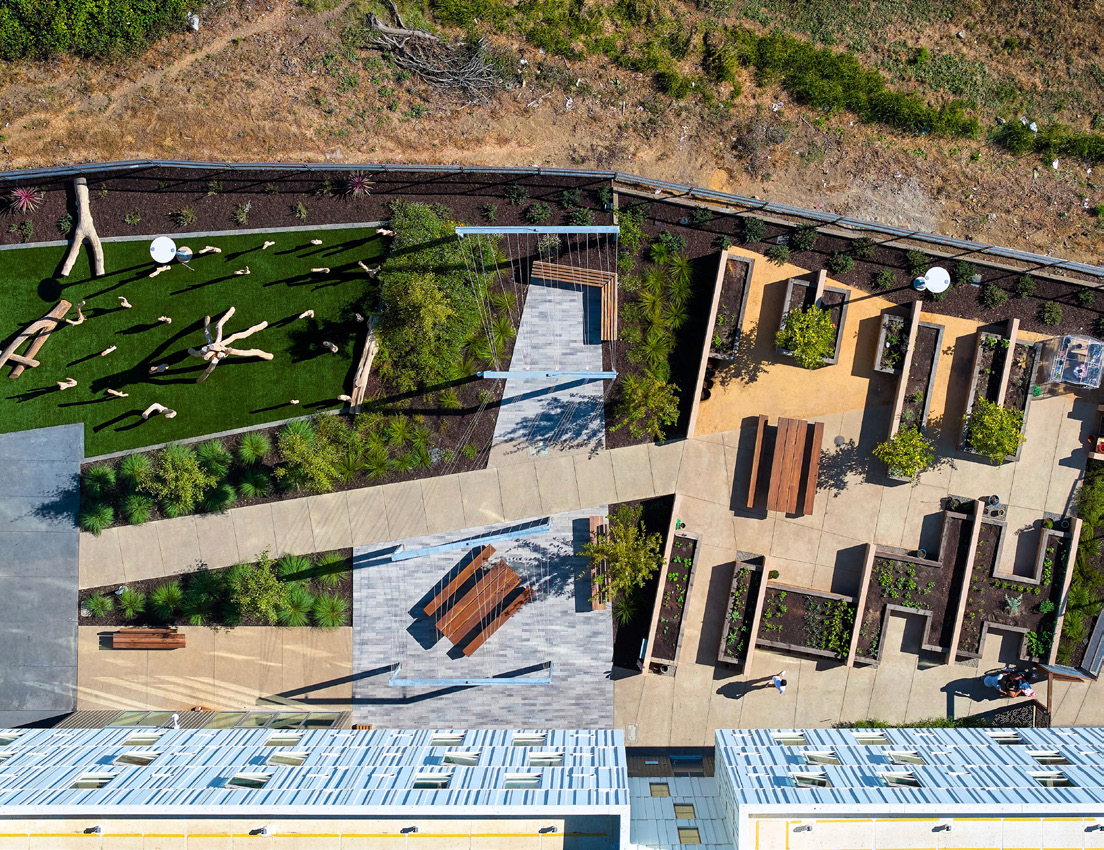
At the rear courtyard, the community garden, play, gathering, and dog run areas are connected by accessible pathways, weaving through native planting areas and integrated green infrastructure.
© Bruce Damonte

A natural play area of log based structures blurs the lines between the site and the natural landscape surrounding the creek beyond. Durable Black Locust timbers are arranged to encourage intergenerational movement and informal imaginative play.
© Barry Schwartz

The central community gathering space serves as an extension of the interior community room, for programmed events or social gatherings. A large reclaimed timber community table situated under a unique vine cable structure grounds the space.
© SPEC Play

Natural play elements and seating reuse salvaged tree trunks, reducing material processing and embodied carbon. The raw wood creates a cohesive landscape language, grounding the site in natural materiality while enriching everyday sensory experience.
© SPEC Play, Bruce Damonte

The courtyard garden incorporates fruit trees, accessible garden beds, and a community table where residents and neighbors can gather to cultivate plants and community.
© Barry Schwartz

The community gardens are designed for long-term care – supporting cultivation, seasonal change, and the quiet rebuilding of relationships between people and land.
© Bruce Damonte
Client
David Baker Architects
Project Team
David Fletcher, Project Manager and Design Lead
David Baker Architects, Architect
Roberts-Obayashi Corporation, General Contractor
Factory_OS, Modular Manufacturer
Murphy Burr Curry, Structural Engineer
FARD Engineers, Mechanical/Electrical/Plumbing Engineer
Luk + Associates, Civil Engineer
BŌK Modern, Facade Panels
Arthur Landscape Irrigation Consulting, Irrigation Designer
SPEC Play, Play Equipment
Project Statement
Located just north of downtown Vallejo, Blue Oak Landing provides 75 supportive affordable apartments, serving families, couples, and individuals experiencing homelessness or who are at risk of homelessness. The project consists of two modular four-story buildings linked across a shared courtyard with views out to Austin Creek. Community garden, play, gathering, and dog run areas are connected by accessible pathways, weaving through native planting areas and integrated green infrastructure. A stand of Blue Oaks (Quercus douglasii) grounds the central courtyard and serves as a hallmark of the community. Endemic to California, Blue Oaks are commonly found in the Coast Ranges and the foothills of the Sierra Nevada.
Project Description
The 1.3 acre site repurposes an underutilized lot along a major thoroughfare in the city of Vallejo, transforming it into a vibrant supportive affordable housing community, Blue Oak Landing. 75 units spread across two modular four-story buildings serve families, couples, and individuals experiencing homelessness or who are at risk of homelessness.
An existing stormwater easement running through the center of the site with strict no-build requirements guided the decision to incorporate two distinct building volumes. Linked by open-air circulation, the building siting harnesses wind patterns to create natural ventilation. The breezeway frames views across the courtyard landscape towards Austin Creek beyond.
The central exterior community gathering space serves as an extension of the interior community room, for programmed events, social gatherings, and passive recreation. At the heart of the space is a large reclaimed timber community table situated under a unique vine cable structure. The adjacent community garden space incorporates fruit trees, such as Citrus and Guava, alongside accessible garden beds, constructed from a combination of timber and CMU walls, where residents can grow their own herbs and vegetables. An additional community table allows residents to share meals surrounded by their ever evolving gardens. Several additional seating nooks are incorporated throughout the landscape, offering space for quiet introspection or additional gathering opportunities.
The dedicated play area utilizes natural timber log play equipment and synthetic turf safety surfacing, allowing the space to blur the lines between site and the natural landscape surrounding the creek beyond. Durable Black Locust timbers are arranged throughout the play area to encourage intergenerational movement and informal imaginative play. A fenced dog run allows a safe space for residents to let their pets off leash. There are a number of outdoor “office spaces”, outfitted with seating and tables that are powered for convenience. These exterior amenities work in tandem with dedicated resident and service uses located throughout the ground floor of the building. Interior services, including a community room with a fully equipped kitchen, computer learning center, and laundry facilities.
Previous site use did not include stormwater management solutions, allowing harmful pollutants to runoff directly into the adjacent Creek. Bioretention areas located throughout the site capture and treat stormwater before releasing it to recharge the adjacent Austin Creek, which feeds down the watershed into the Napa River and, eventually, the San Pablo Bay. An existing stand of established trees along Austin Creek were preserved, maintaining the riparian character and functional bank stability. Native and climate-adapted plant species were selected to reduce long-term irrigation demand and support urban wildlife. The planting palette emphasizes drought–tolerant species and pollinator–supporting perennials, providing year-round texture and habitat value, adjacent to an important local wetland ecosystem. Seasonal blooms attract pollinators such as butterflies, bees, and hummingbirds. Planting design complies with and exceeds MWELO water-use standards.

