Urban Forest Edge
Merit Award /
2026, Residential Design
San Francisco, California
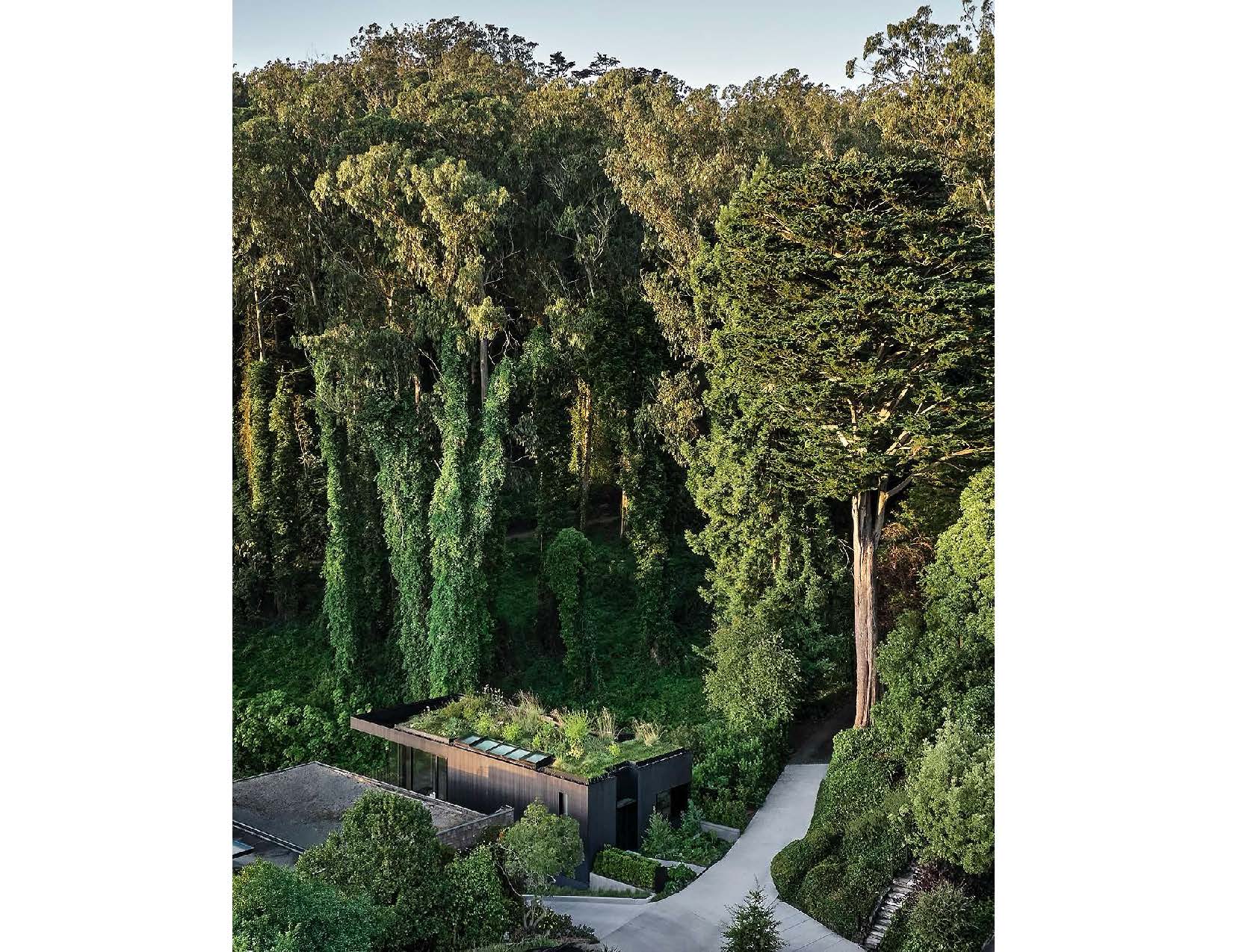
This site sits on the edge of a 19-acre wooded urban green belt. The Landscape Architect and Architect worked to integrate the home into the neighborhood streetscape and the forest beyond. Here, the driveway descends to the lower garden.
© Andrea Gaffney

The home and terraces step down the 3,300 SF sloped site, following the natural grade to the forest floor. Including the roof, the surface area at the property is almost 100% permeable. California natives comprise 75% of the plantings.
© Scott Lewis Landscape Architecture
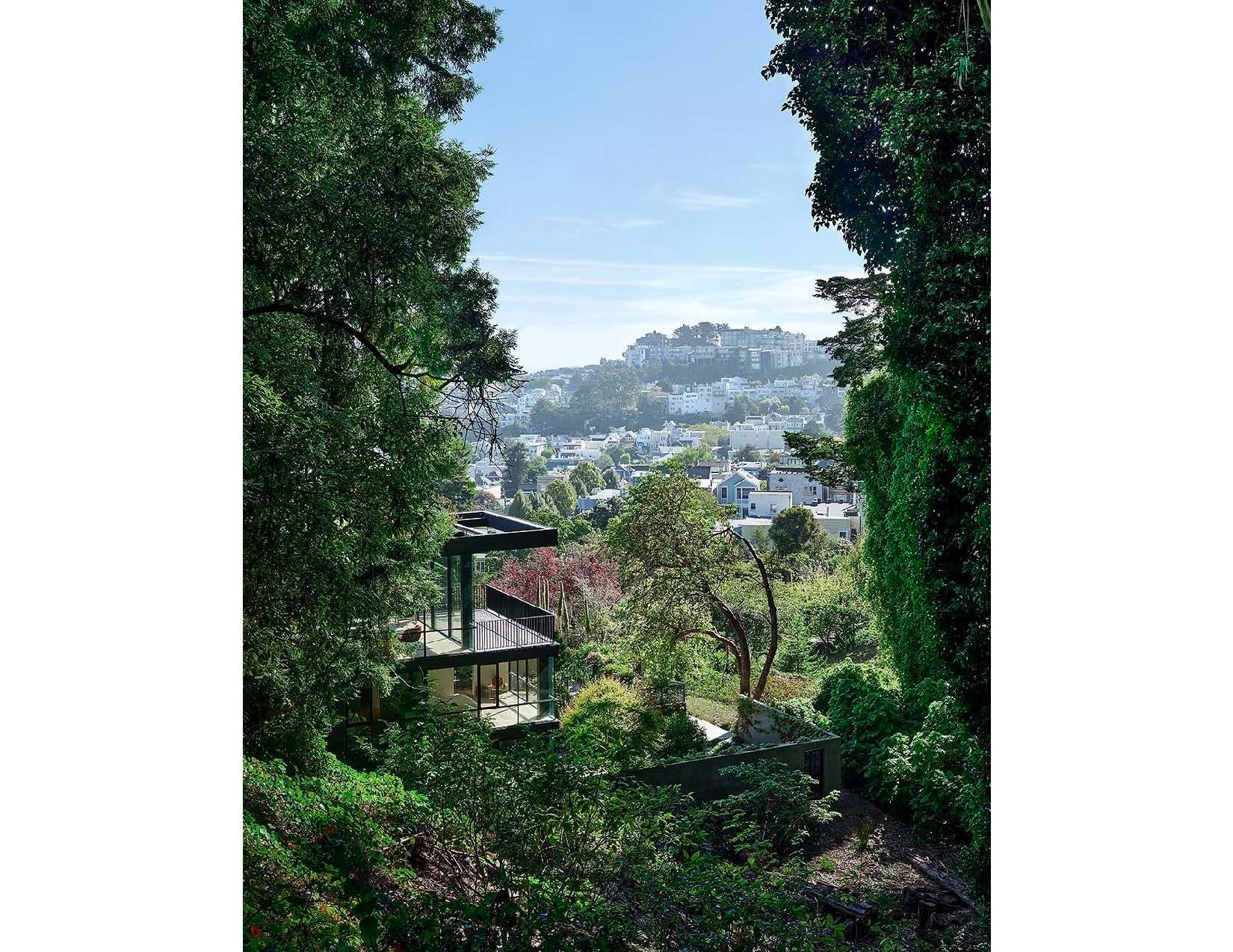
The home straddles the margin between the forest and the hilly urban neighborhood. A curving Madrone (center right) a neighborhood-favorite received special care during construction to prevent any root impact.
© Andrea Gaffney

The clients wanted their home to visually represent their commitment to supporting local birdlife. Hence, the Roof Garden plantings of native perennials, grasses and shrubs are visible from the sloped street.
© Marion Brenner

Up on the Roof Garden, over 25 different native plants were chosen for their part in supporting the lifecycle of birds and pollinators. Compatibility with the microclimate and being able to thrive in rooftop conditions were critical in plant selection.
© Andrea Gaffney

Rooftop plants, all natives, include a variety of grasses, perennials and woody shrubs. These foster the local bird population and provide full lifecycle support for beneficial insects and pollinators.
© Andrea Gaffney

The front woodland garden is unenclosed to the street, signaling the clients’ interest in connecting to the neighborhood. The gently curved entry walkway is made of tightly fitted trapezoidal pieces of Cenia Azul limestone.
© Andrea Gaffney (left), © Marion Brenner (top right), © Andrea Gaffney (lower right)

At Rear Garden’s entrance from the driveway, planted step stones serve as a guest parking spot and as access to the forest gate. Architectural concrete walls with “light sand” finish define the Rear Garden edges, planted with native California Grape.
© Marion Brenner
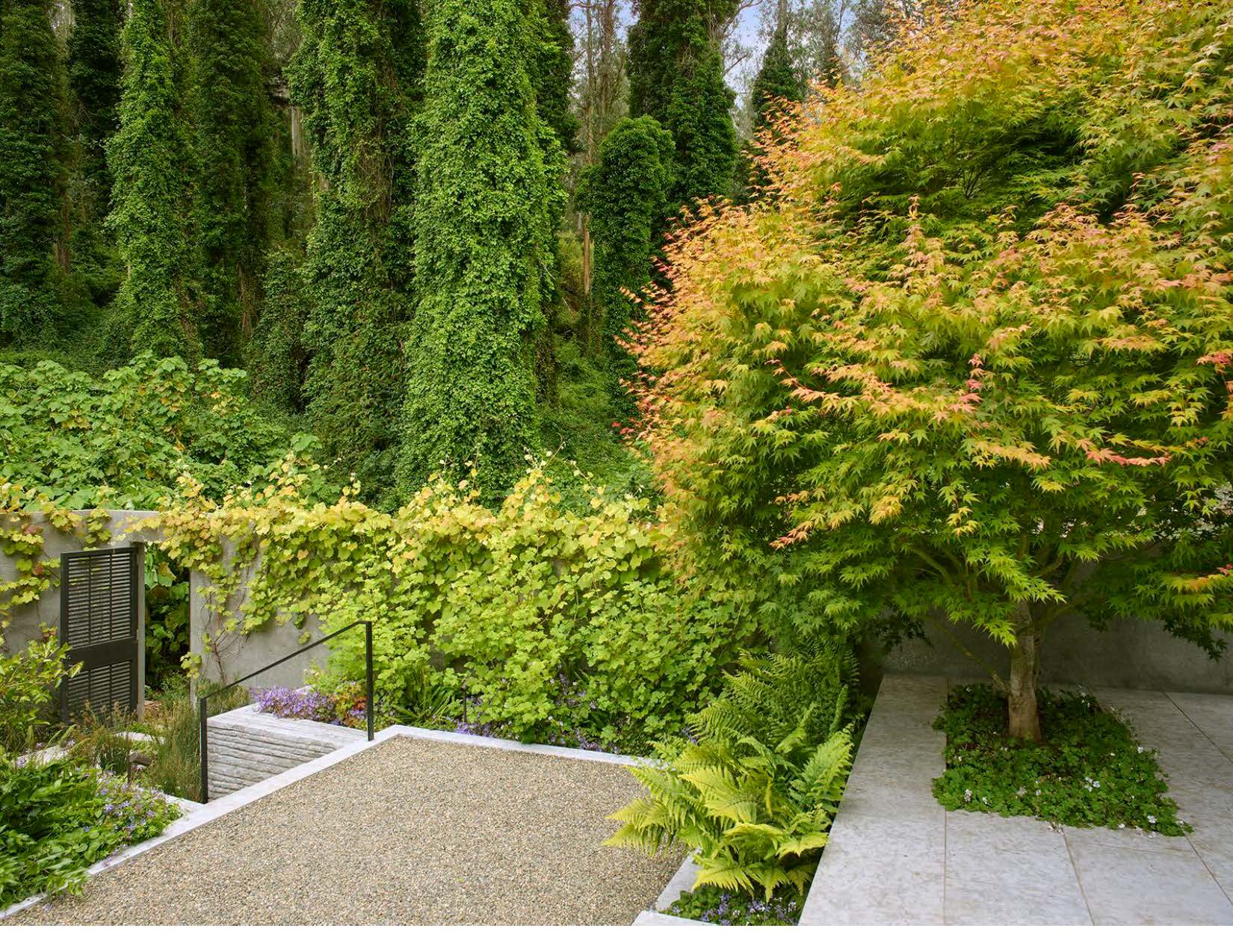
As the Rear Garden terraces lead up to the home, the wall height decreases, allowing forest views. California Grape, Winter-Flowering Currant, and Deer Fern on the perimeter walls evoke the dense tree grove beyond.
© Marion Brenner

The Rear Garden’s hardscape character of ribbed split-face limestone walls and gravel transitions to more refined flamed limestone slabs at the house. Around the edges of the gravel terrace, layered plantings provide color, interest, and habitat.
© Marion Brenner

At top, shady ground covers overlap flamed Cenia Azul limestone paving. At bottom, Deer Fern and California Rush are juxtaposed with ribbed splitface Cenia Azul limestone walls. Left, the stone was elected to compliment the concrete walls’ tone and texture.
© Marion Brenner (left), © Andrea Gaffney (both right)

Seen from inside the Rear Garden, custom metal panels atop the driveway wall provide privacy and support the California Grape. Trailing vine stems and their Fall color contrast with the refined architectural concrete finish.
© Andrea Gaffney

From the home’s lowest level looking out to the Rear Garden, the terraces offer peaceful bird-watching spots for the clients who are avid birders. The landscape flows from the house to merge with the 100-year-old urban tree grove.
© Marion Brenner
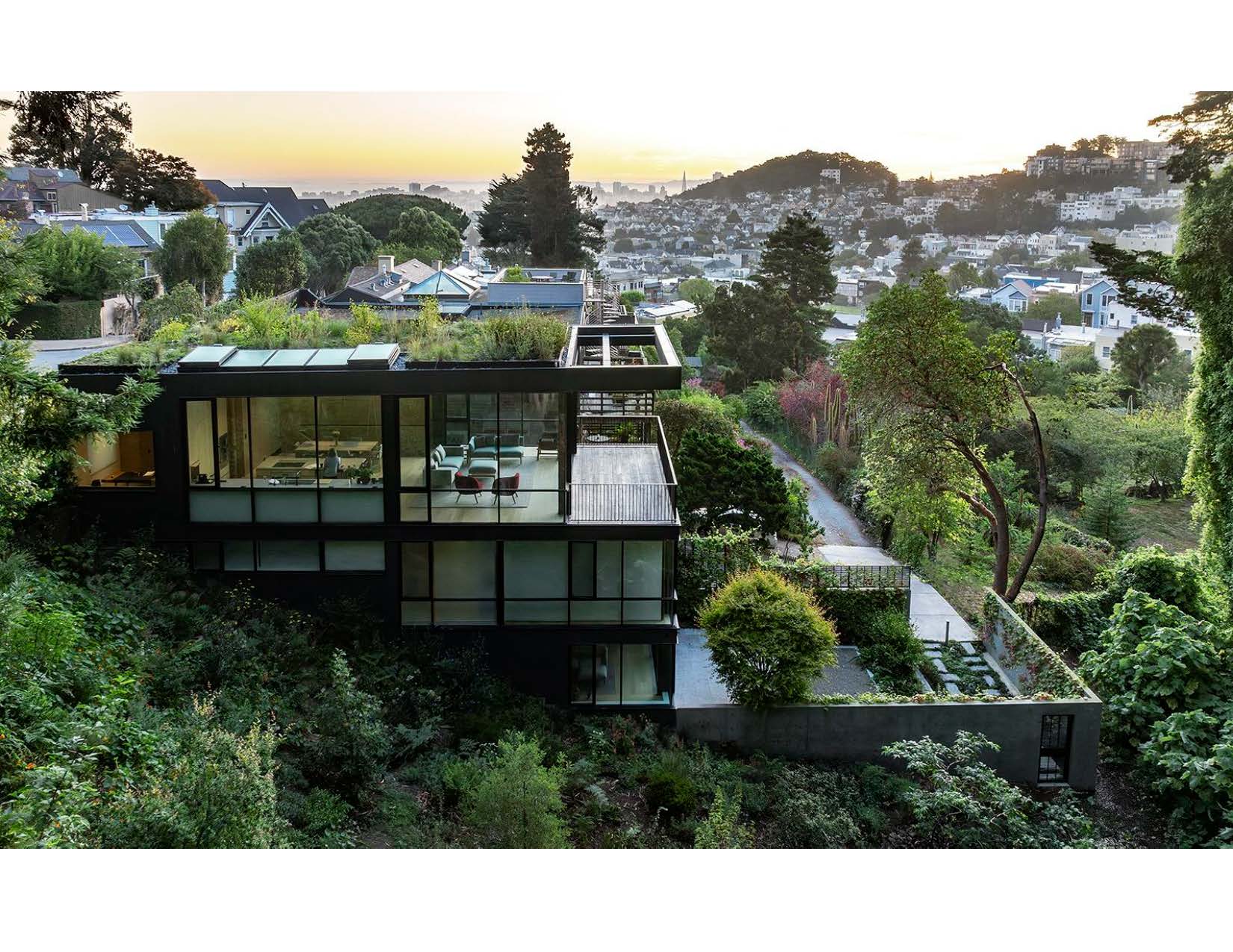
The view from the forest to the city neighborhoods reveals the sensitivity of the site design. The house and Rear Garden are in scale with the surrounding neighborhood.
© Andrea Gaffney
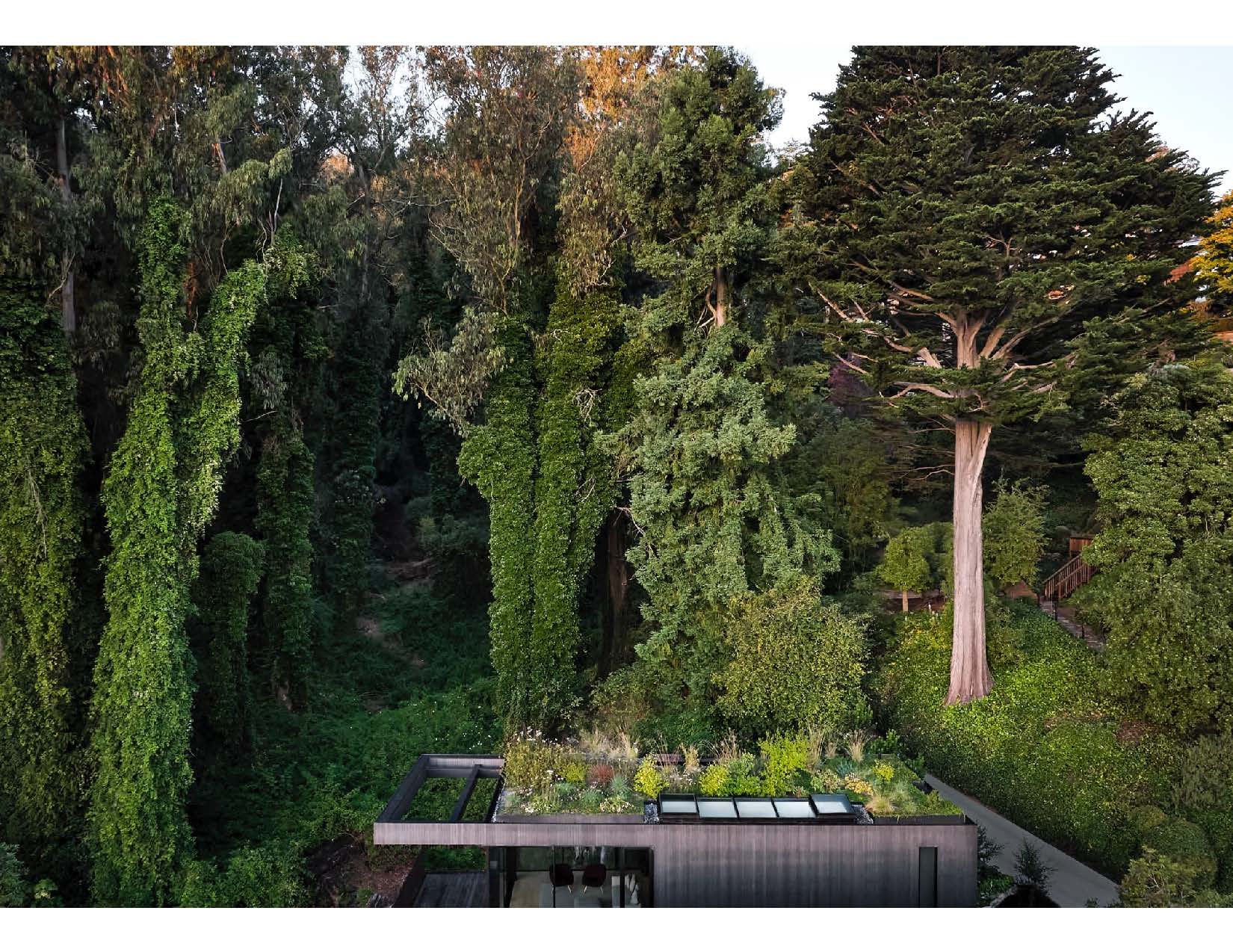
The home’s gardens will stand as a pollinator and bird haven even as the mature forest evolves in the future. The intensively planted project demonstrates how urban residential lots can provide significant habitat which fosters aerial connectivity within the city.
© Andrea Gaffney
Client
N/A
Project Team
Scott Lewis, Lead Landscape Achitect
Ceyrena Kay, Project Manager
John Maniscalco and Kelton Dissel, Architects
Andrew McHale and Justin Carroll, General Contractor
Terra Ferma Landscapes, Landscape Contractor
Roy Leggitt, Project Arborist
Project Statement
Bordering a 19-acre wooded public greenbelt, the landscape architecture for this San Francisco home personifies its owners‘ primary mandate: design to support local birds. As long-time community members, the clients wanted an unobtrusive residence that honored the neighborhood’s unique nature. This site creates native habitat for birds and pollinators on nearly every plantable surface, using 50 species of trees, woody shrubs, grasses, vines and perennials carefully selected for their part in supporting avian and insect lifecycles. Seventy five percent of the plantings are natives.
Permeable materials cover almost all exposed areas of the entire 3,300 SF lot. On its steep slope, the site blends contemporary architectural sensibility with thoughtful hardscape details and layered plantings to become a welcoming hub for both regional birds and nearby neighbors. This project demonstrates how small urban residential lots can maximize local habitat to increase biodiversity and provide connectivity between habitats within the urban fabric.
Project Description
The 3,300-sf property is on a steep slope, at the edge of a 19-acre wooded public greenbelt in San Francisco. The owners wanted a new home to replace their existing aged house, created with careful attention to site sensitivity, neighborhood scale and creation of bird habitat.
Complement the Context
The Landscape Architect and the Architect developed a site plan that allowed the building mass to progressively step down the steep grade by using a series of terraces to meet the forest floor at the lowest level. Consequently, the three-story 3,800 SF home sits in scale with the local street massing.
The Rear Garden’s perimeter concrete walls, with their subtle “light sand” finish and exposed-form tie holes, serve as an architectural extension of the building’s foundation while creating privacy. The wall height was calibrated to create a uniform level from waist high at the upper terrace, allowing a wide bird-watching panorama, to a height sufficient for a forest access gate at the lowest level.
The textured massing of plantings on multiple levels softens the contemporary geometry of the architecture, blending the property into its forest setting. The Front Garden is purposely not enclosed by walls or hedges in response to the owner’s desire to maintain a visual connection to the street and be part of daily neighborhood activity. The wide front path curves to the door with an artful polygonal stone pattern. In the Rear Garden, the plantings and stonework get deliberately more rustic in character as the garden steps downhill to meet the tangled forest.
Create Habitat
The clients were committed to maximizing bird habitat. The Landscape Architect recommended developing the Roof Garden, thereby doubling the available site area for planting. The adjacent public forest hosts 50 species of birds, 20 species of butterflies, and numerous species of bees and insects. The resultant mix of native plantings on the Roof Garden, benefiting all this local fauna, can be seen from the street and visually demonstrates the owner’s dedication to the tree grove and its creatures within. The Roof Garden demonstrates the feasibility of establishing a native mini-eco system in an urban setting.
Native California Grape, an important habitat plant for Coastal landscape, is also visible from the driveway atop the Rear Garden walls. Overall, 50 species of trees, woody shrubs, grasses, vines and perennials are used at the site, 75% of which are native plants matched to foster the local insect population (a major food source for birds) and for avian feeding and shelter.
Effect Ecological Practices
With strong collaboration between the Landscape Architect and the Architect, the property’s exposed surfaces are now nearly 100% permeable. The step stones at the lowest terrace in the Rear Garden can support a vehicle if necessary — eliminating the need for a garage structure — while maintaining their planted pathway character. The porous Roof Garden surface, with 12“-14” of soil medium and moisture retention cups, slows down storm runoff. All hardscape surfaces are high albedo.
All site lighting is Dark-Sky compliant and kept to a minimum to not disturb migrating birds and insects.
All plantings on the site are local microclimate compatible, with the roof garden palette chosen for tolerating shallower soils, higher wind, and solar exposure. The plantings are low maintenance and drought tolerant. Drip irrigation is used throughout the site, and outdoor water usage is well below
limits set by The City. Leaf litter is left in place to provide shelter for caterpillars and beneficial insects while contributing organic matter to the soil. Garden cuttings from the native plants are used on site and donated locally, in support of the green belt’s volunteer steward organization’s habitat restoration efforts. The Landscape Architect initiated construction measures to avoid impacting a favorite neighborhood tree, a sculptural arching Madrone which borders the Rear Garden. Siting, design and plant selection make this forest-edge home a thriving habitat for birds, pollinators and humans.