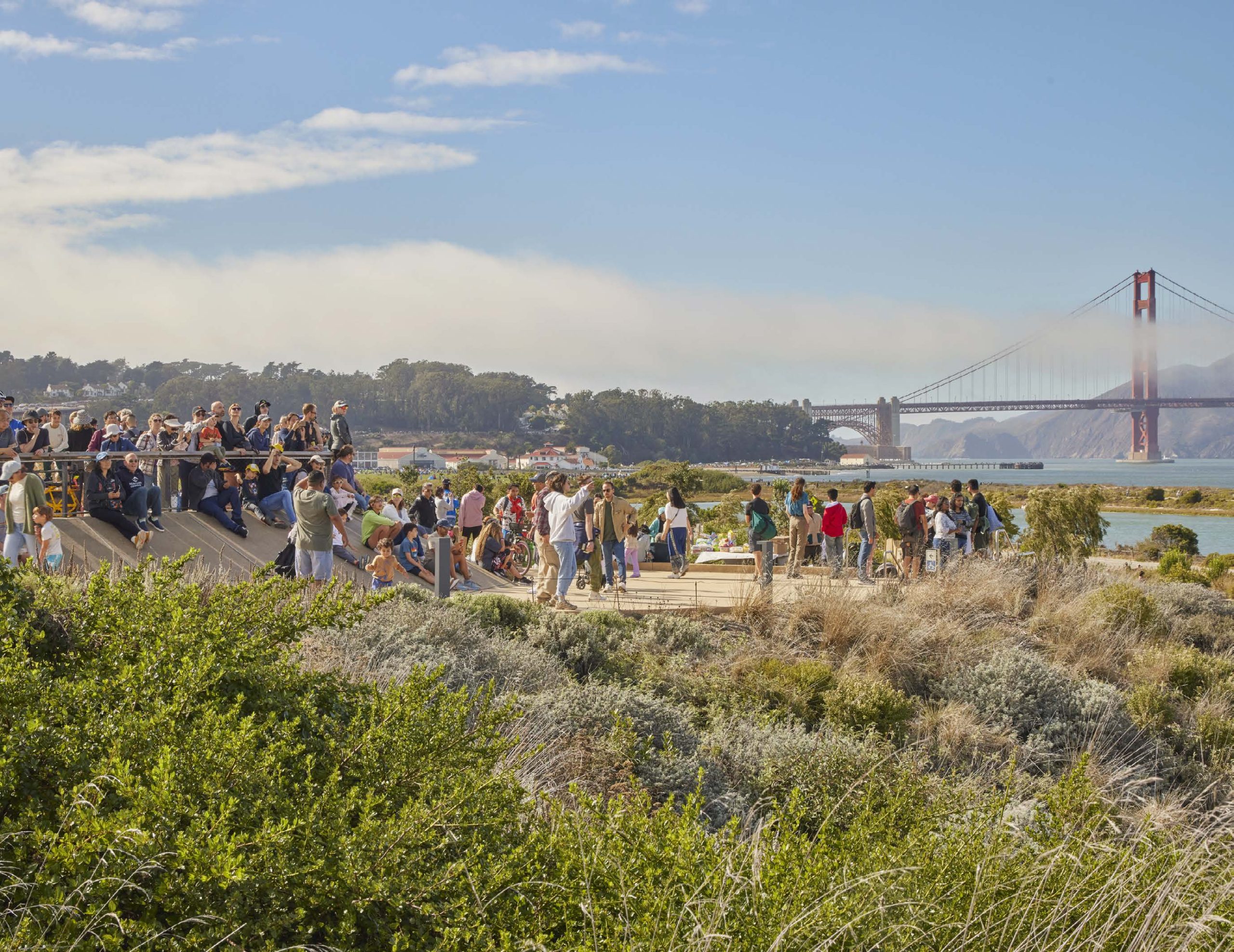
The Presidio Tunnel Tops is a great reserve of nature, ecology, culture, and history. The park leverages this extraordinary position to create a magnificent new place for all of San Francisco, effectively connecting City to Bay.
© Caitlin Atkinson

After decades of visioning and planning work to remove an existing highway viaduct damaged by the 1989 earthquake, newly built cut-and-cover tunnels allowed an invaluable opportunity to build a park atop the tunnels to connect the Presidio to its waterfront.
© Field Operations

The team designed the park so visitors find delight in experiencing the 360-degree horizon. Each pathway, furnishing, and feature is choreographed so that every perch feels like it’s the absolute best place to view the bridge and Bay.
© Caitlin Atkinson

Presidio Tunnel Tops leverages its extraordinary position to create a magnificent new place for all of San Francisco, effectively connecting City to Bay, Presidio to Crissy Field and Crissy Marsh, and historical and cultural legacy to future generations.
© Caitlin Atkinson

The Cliff Walk runs along the upper edge of the bluff, connecting the western and eastern parts of the site and offering stunning views. Oversized seating benches are sculpted to provide generous seating and create shelter from the wind.
© Caitlin Atkinson

Presidio Tunnel Tops is the home to several buildings, new and existing. The project sits within a National Landmark Historic District, and as such, the design of the park highlights and honors the military significance of the Presidio.
© Caitlin Atkinson

The park’s design embodies restraint and simplicity, seamlessly integrating with its surroundings without overpowering them. Native plantings, natural materials, and thoughtfully measured interventions enhance sensory engagement while preserving a sense of openness and discovery.
© Caitlin Atkinson

The Presidio was once a grassland that transitioned to a coastal scrub community. The design uses climatically adapted native and non-invasive species that reflect the site’s context and represent a strategic and long-term approach to the park’s planting.
© Caitlin Atkinson

The Eastern Meadows include curated garden spaces, including meadows mixed with soft grasses, perennials, and bulbs, that offer a simple and serene horticultural experience to stroll and take in the horizon.
© Caitlin Atkinson

The Outpost is a 2-acre, unique child-friendly landscape of multi-sensory and place-based learning. Its features are geared toward a wide variety of play experiences while providing a range of physical challenges and opportunities for learning, free play, and investigation.
© Caitlin Atkinson

The Presidio Steps connect the Cliff Walk to the Outpost below, navigating the steep bluff elevation change in a way that allows visitors to experience the topography while enjoying the view. Lawn seating steps create a series of viewing terraces.
© Caitlin Atkinson

Presidio Tunnel Tops includes four overlooks: the Parklands Overlook, Veterans Overlook, Crossroads Overlook, and Bay Overlook. Carefully shaped topography blends these overlooks into the bluff, creating an open and highly dramatic experience, while providing 360-degree panoramic views of the park.
© Caitlin Atkinson

The park orchestrates a dynamic interplay of gathering spaces, varying in scale and character to accommodate a broad spectrum of users. Each space is positioned to frame views and extend sightlines, creating an ever-evolving dialogue between people, landscape, and horizon.
© Caitlin Atkinson

The site plan is structured by two primary pathways: the East Esplanade, which connects the Presidio and Main Post to the Crossroads and Bay Overlooks; and the Cliff Walk, which ties the western and eastern parts of the site together.
© Field Operations

Set within a reserve of wild landscapes, ecological habitats, and horticultural settings, the Park’s design prioritizes keeping with the character of its surroundings as a simple, open, and vegetated landscape for people to explore and enjoy the scenery.
© Caitlin Atkinson
Client
The Presidio Trust
Project Team
EHDD, Architecture & Facilities
Magnusson Klemencic Associates, Civil, Site Structural & Stormwater Engineering
Miller Pacific, Geotechnical Engineering
WOOD, Environmental Engineering
Stok, Sustainability Consultant
Project Statement
Presidio Tunnel Tops reimagines a once-elevated highway into a vibrant, ecologically rich 14-acres of public space. Built atop 7 lanes of Presidio Parkway tunnels, the new landscape stitches together historic parklands with the San Francisco Bay and transforms infrastructure into an immersive experience, choreographing movement, topography, and ecology to create an open, accessible pedestrian connection across 40 feet of grade change. The park has become a central place for the community with a network of trails, bluff landscapes, meadows, dynamic overlooks, and spaces for gathering.The park blends essential community anchors— including a new transit center and pavilion, a campfire circle, and a youth-focused educational campus— with gardens reflecting the site’s natural and cultural history. It offers both connection and retreat, balancing quiet contemplation with social engagement. Through fluid and experiential design, Tunnel Tops transforms infrastructure into landscape, and movement into experience, to create a timeless public space for all.
Project Description
Reclaiming Infrastructure as Landscape
Decades of planning catalyzed the removal of the former highway viaduct and replaced it with cut-and-cover tunnels engineered by Caltrans. This intervention unlocked an opportunity to weave the historic Main Post of the Presidio seamlessly into its waterfront setting, creating a new civic threshold between city, nature, and the Bay. The process of designing atop an infrastructural corridor demanded technical innovation and multi-disciplinary collaboration. Working closely with CALTRANS, the Presidio Trust, and a constellation of partners, the design team navigated the complexities of building a park atop highway tunnels—where loading restrictions, soil depths, and structural tolerances required both technical rigor and ingenuity.
Public Engagement as a Design Catalyst
The design process embraced an inclusive and iterative engagement model, transforming public input into a fundamental design driver. The Presidio Trust and Field Operations orchestrated a series of workshops, briefings, and outreach events, ensuring that thousands of San Franciscans could contribute their ideas, priorities, and visions for the park. Attendees sketched, wrote, and debated ideas, generating insights that directly shaped design decisions. Requests for expanded picnic spaces, optimally scaled lawns, and diverse activity zones were woven into the evolving framework, ensuring that Tunnel Tops would feel both expansive and intimate, structured yet organic.
Sustainability
Rooted in principles of ecological renewal, material reclamation, and urban resilience, the landscape of Tunnel Tops is designed to integrate with, rather than impose upon, its remarkable setting. The site’s LEED Gold-certified buildings and ReScape (Bay Friendly) certified landscapes are part of a broader ethos of sustainability—where every material, plant, and construction technique reflect a commitment to longevity and adaptability. A defining feature of this commitment is the use of reclaimed materials, sourced directly from the Presidio itself. More than half of the new buildings and furnishings were constructed using fallen or cleared Presidio trees, extending the lifecycle of these natural resources in ways that are both practical and poetic.
Planting & Ecology
Presidio Tunnel Tops emerges as a layered and evolving ecological framework, blending historic landscapes with forward-thinking restoration strategies. The heart of the Presidio was once a grassland that transitioned to a coastal scrub community as it met its waterfront. That character has been translated into the planting design -creating a gradient of ornamental gardens, meadows, lawns, coastal woodland, bluff and dunes, weaving together a diverse array of over 200,000 plants. The planting strategy embraces succession and adaptation—where younger plantings establish resilience against the site’s prevailing winds, and the landscape itself evolves with time. The result is a living, breathing ecological system, one that not only supports biodiversity but also amplifies the sensory experience of the park.
Architecture as a Frame for Landscape
At the top of the bluff, the renovated Transit Center welcomes visitors with expanded gender-inclusive restrooms and an inviting outdoor patio, offering a vantage point to take in the breathtaking views. Below, a new 17,000 sf Youth Campus is a hub of environmental education and play that is seamlessly integrated into the landscape. The historic Building 603 and the new Lab Building provide flexible space for education programs, while the Field Station engages visitors in hands-on exploration of the Presidio’s layered history, ecology, and archaeology. The outdoor counterpart of the Youth Campus is the Outpost, an innovative nature-based playscape that is designed to cultivate imagination and sensory engagement. It extends learning beyond the classroom, inviting children to climb, build and discover within a landscape that feels both natural and adventurous.
Design with Restraint
Tunnel Tops occupies a spectacular setting—a National Park within a Historic Landmark District, surrounded by an iconic cultural and ecological landscape. Here, the power of the design is in its ability to amplify the qualities of place rather than overwhelm them. Buildings and landscape elements have been meticulously detailed to blend seamlessly into the site, ensuring that materials, colors, and forms accentuate the stunning qualities of its context. Trails, garden spaces, and furnishings are carefully choreographed to frame shifting perspectives, quiet moments, and grand overlooks, ensuring that every perch and position feels intentional.
Impact
Within its first year since opening, Tunnel Tops hosted nearly 2 million visitors, welcomed 100 community-based organizations, and featured a dozen community-curated events, drawing thousands across the Bay.