Building Resilience: Implementing a Practical Climate Action Plan
Merit Award /
2025, Research and Communication, Biodiversity and Climate Action
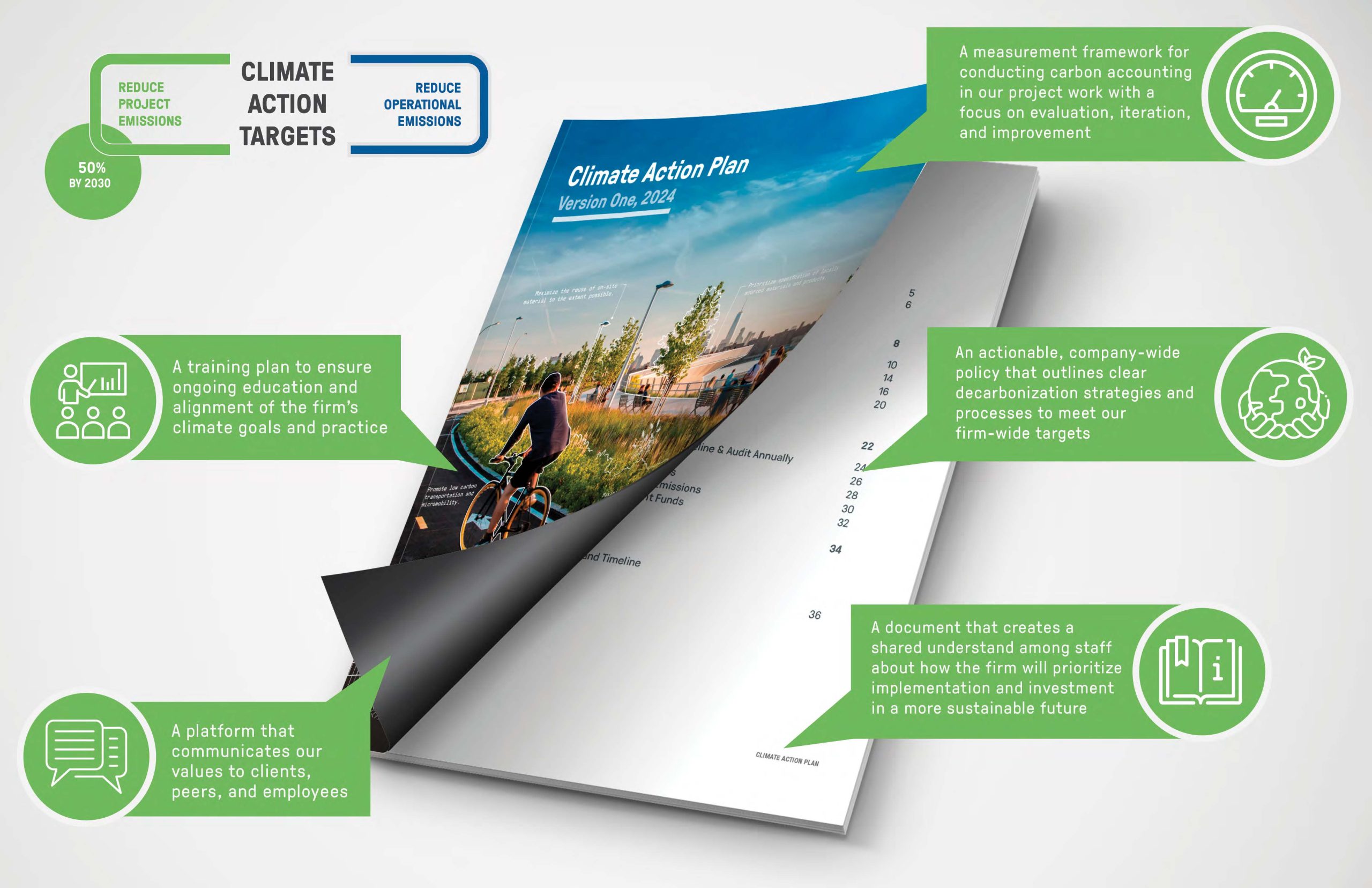
The first of its kind for a landscape architecture firm, the Climate Action Plan sets clear targets and outlines a practical plan for taking carbon emissions across the firm.
©David Lloyd

At its core, the plan aims to incorporate carbon accounting into the firm’s design process. The goal: reduce carbon emissions of projects without compromising on beautiful, high-functioning design.
©Bill Tatham

Split into two chapters, Chapter 1: Decarbonize Our Practice focuses on building a company culture and creating new operational processes that support decarbonization of project work.
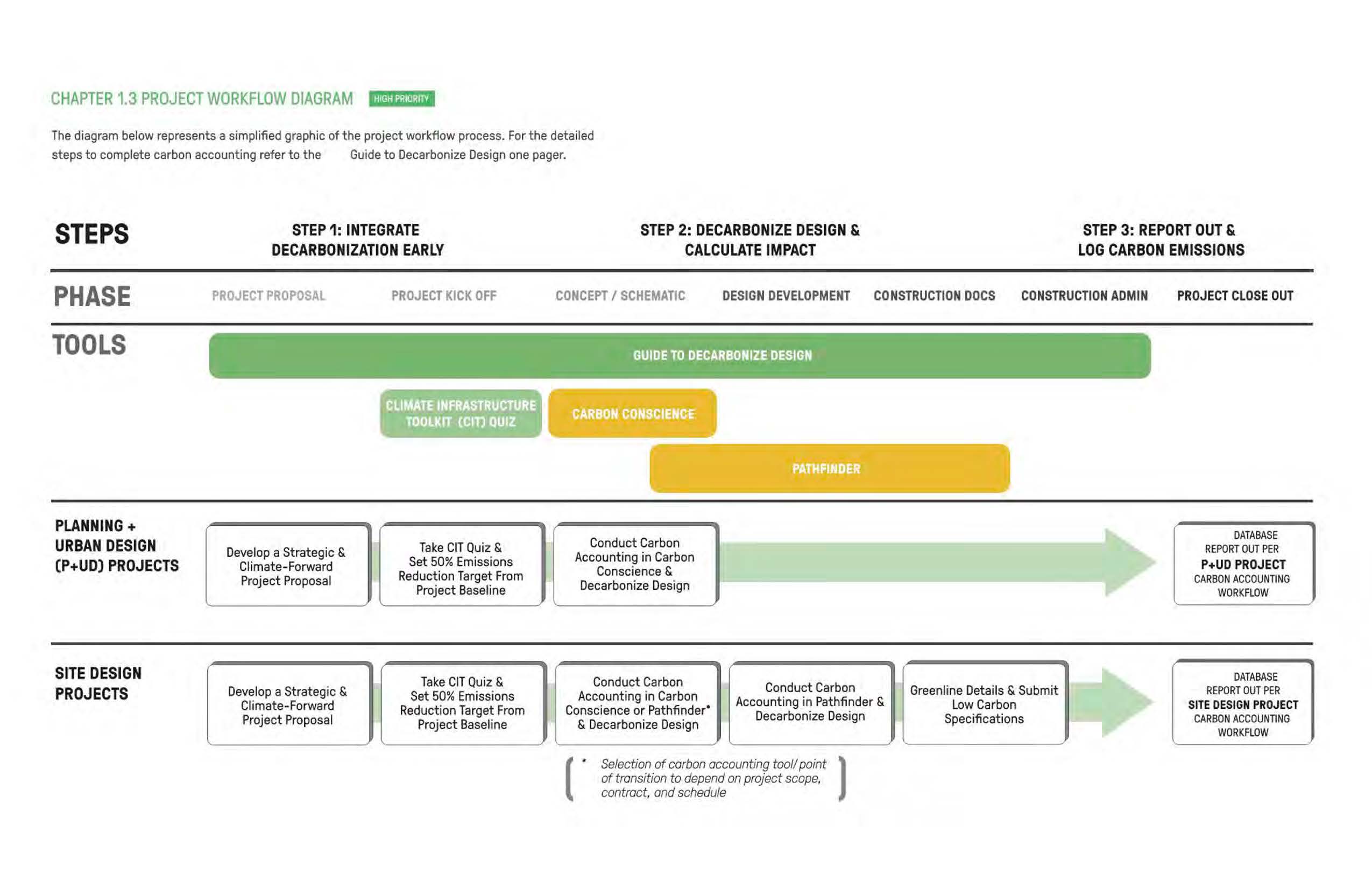
Collaborating with the ASLA Biodiversity and Climate Action Committee, as well as representatives from Pathfinder and Carbon Conscience, the team developed a sample project workflow to guide project decarbonization efforts.
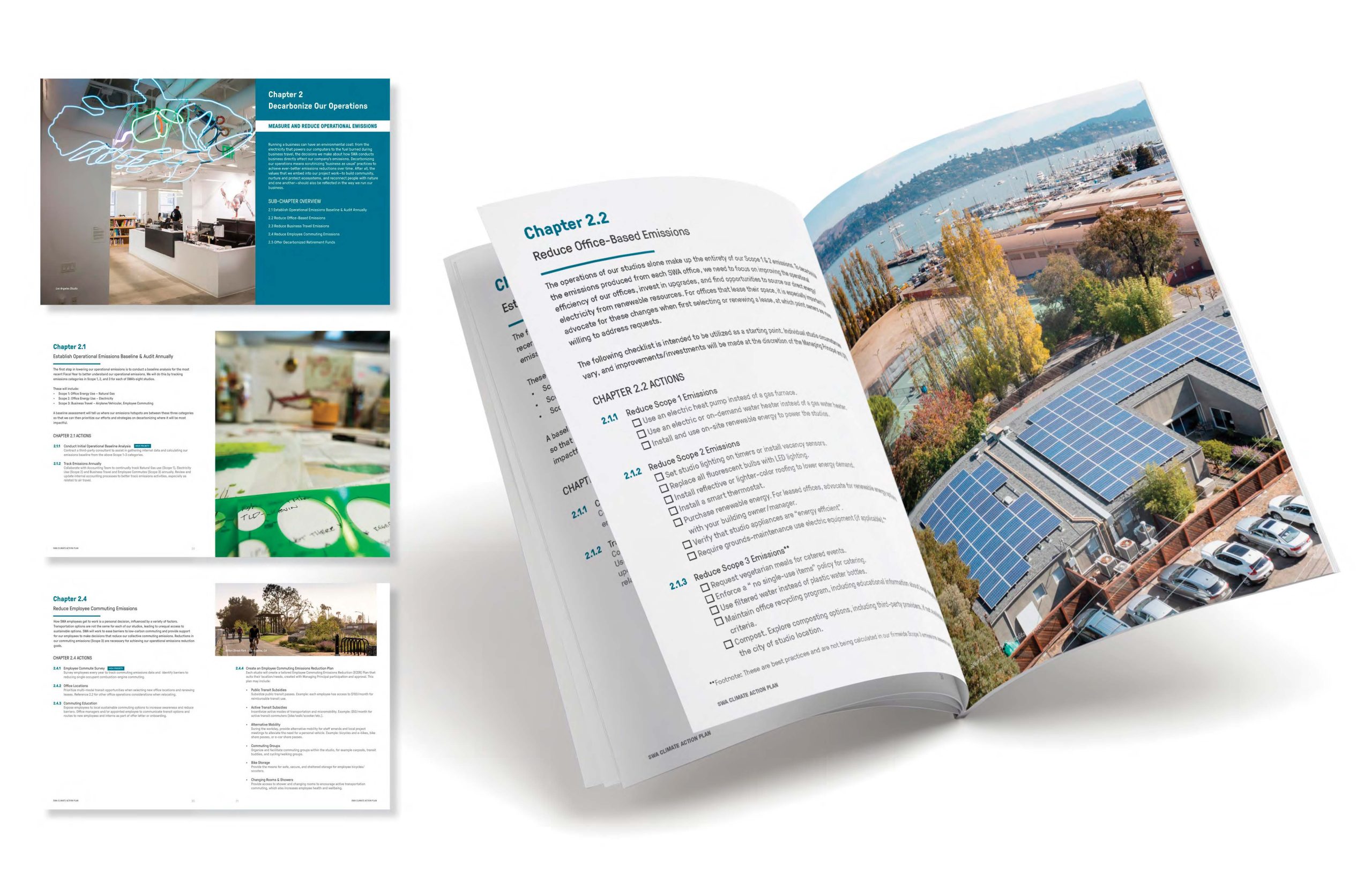
Decarbonize Our Operations focuses strategies for decarbonizing the day-to-day operations of running a multi-office design firm.
Designer education is a fundamental pillar of building a company culture that supports decarbonization; weekly firmwide ‘Sustainability Snacks’ represent one specific strategy for offering regular and easily-digestible information.
Client
Project Team
Mariana Ricker, Lead Landscape Architect
Sarah Fitzgerald, Co-Author
Jonah Susskind, Co-Author
Project Statement
Developed with input from every role and experience level across the firm, the Climate Action Plan (CAP) sets a new standard for addressing the climate crisis, serving as a model for transformation through bold targets and practical actions. It emphasizes reducing project and operational emissions through tools like the Guide to Decarbonize Design and robust carbon tracking. By embedding emissions reduction into all aspects of work, the firm is boldly supporting a cultural shift toward collective climate action within the landscape architectural community.
Project Description
We are living through a climate crisis. Annual global CO2 emissions continue to rise, and scientists have issued urgent warnings that the world must achieve comprehensive reductions in global emissions across every sector of the economy by 2030 to remain below the critical 1.5°C warming threshold.
In response to the pressing need for action, the firm developed a groundbreaking Climate Action Plan (CAP) designed to align with science-based targets set by the Intergovernmental Panel on Climate Change (IPCC), the American Society of Landscape Architects (ASLA), and the Architecture 2030 Challenge. The CAP outlines a bold strategy targeting a 50% reduction in emissions from project work by 2030. This first milestone is critical to achieving a net-zero emissions landscape architecture industry by 2040.
The CAP focuses on reducing emissions generated by both project work and business operations. Recognizing that project emissions far outweigh operational emissions, the firm prioritized integrating decarbonization strategies directly into the design process. Using a benchmarking analysis and a growing suite of carbon accounting tools, the firm is establishing a process to measure embodied and sequestered carbon across multiple project typologies. By collecting and analyzing both retroactive and active project data, the firm aims to guide decision-making and track emissions reductions by category. This iterative approach fosters continuous improvement, helping design teams refine their methods to achieve increasingly impactful results.
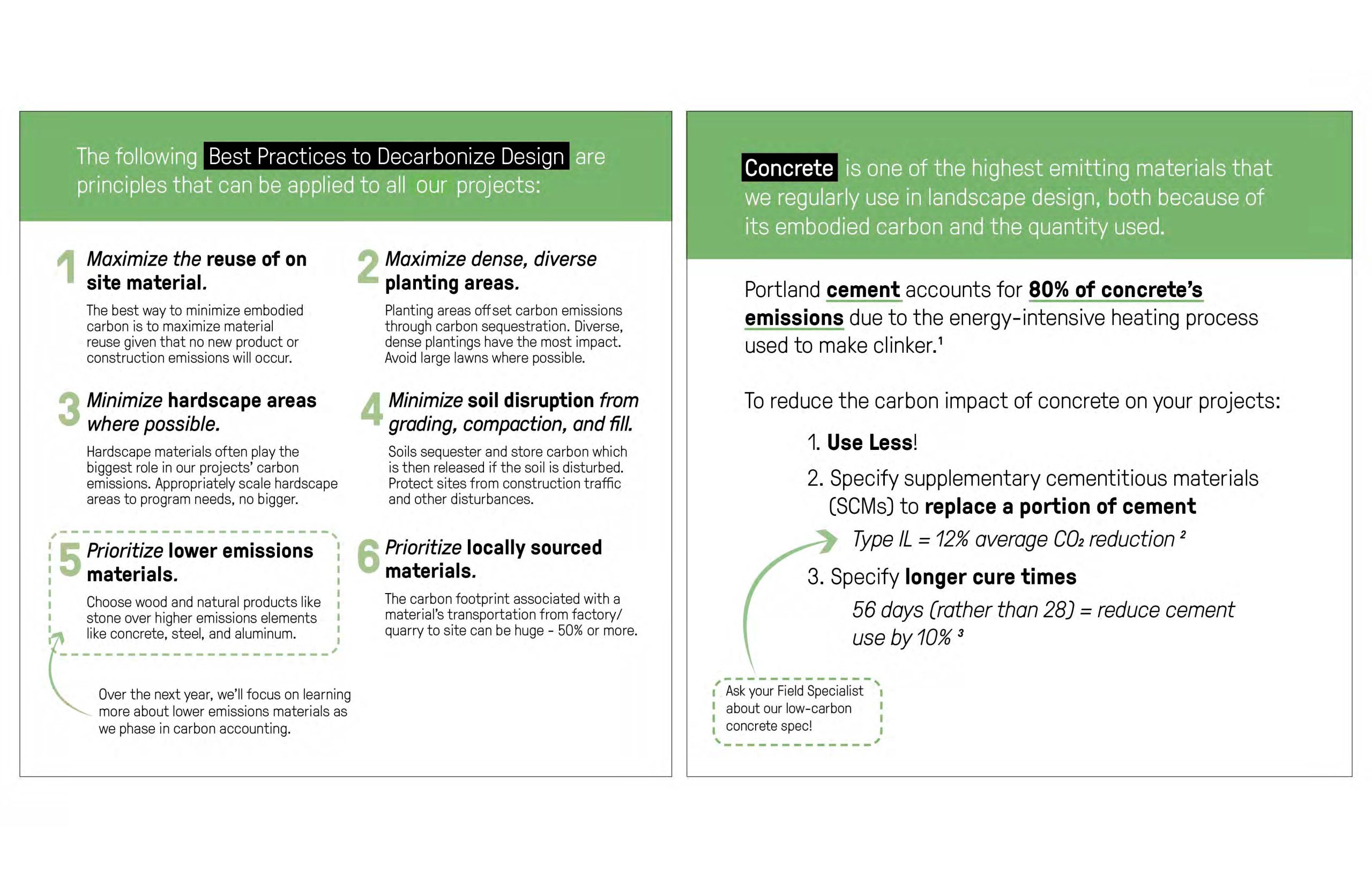
A key component of the CAP is the firm’s Guide to Decarbonize Design, a phase-by-phase toolkit that empowers teams to incorporate low-carbon strategies from the earliest stages of a project. Developed through an internal fellowship, this guide prioritizes right-sizing spaces, selecting low-carbon materials, and streamlining construction details to minimize embodied carbon. By embedding carbon-conscious practices into every stage of design, the firm ensures that decarbonization remains a top consideration across its entire portfolio.
The CAP also emphasizes the importance of education and training to align the firm’s climate goals with daily practice. By fostering a culture of learning and collaboration, the firm equips its teams with the knowledge and tools needed to achieve meaningful emissions reductions. This commitment to professional development ensures that sustainability is not only a strategic priority but also an integral part of the firm’s identity.
While the firm’s primary focus is on reducing project emissions, the CAP also addresses operational emissions. Strategies for reducing office energy consumption, business travel emissions, and commuting impacts are being implemented across all offices. These measures reflect the firm’s commitment to aligning its internal practices with the values it champions in its project work. By scrutinizing traditional “business-as-usual” practices, the firm aims to model a culture of sustainability that inspires both employees and industry peers.
The CAP is not merely an internal policy; it is a platform for leadership and advocacy. The firm intends to share insights and lessons learned, thereby elevating the role of landscape architecture in the global effort to decarbonize the built environment. Collaboration with allied disciplines, including architects, engineers, and urban planners, is key to addressing the interconnected challenges of climate change. The firm’s research-driven approach underscores the importance of collective action, with the CAP serving as a model for industry-wide transformation.
The CAP was developed through a year-long planning effort which integrated voices from every office and across every role in the company. A core 13-person Task Force comprised of principals to design staff incorporated feedback from firmwide surveys, workshops, and ASLA best practices, a larger firmwide Advisory Committee, and independent research to produce the final document. The CAP also benefited from the external review of Pamela Conrad, Climate Positive Design founder and Chair of the ASLA’s own previously published Climate Action Plan, to ensure the document’s impact aligned with field-wide goals and best practices.
As the first landscape architecture practice to develop a Climate Action Plan of this scope, the firm is setting a new standard for the profession. The CAP demonstrates that bold, science-based action is both possible and necessary to address the climate crisis. It challenges the industry to reimagine the role of landscape architects as leaders in decarbonization and climate justice. By integrating emissions reduction into every facet of its work, the firm aims to inspire a broader cultural shift within the design community.
2025 NCC Award Jury
“An Inspiring Plan and first of its kind by a landscape architecture firm to tackle a complex subject to lead the way to changing the firm’s practice and projects by focusing on building a company culture and creating new operational processes that support decarbonation in both practice and project work. One of its innovative strategies to change culture is by adding the educational component as pillar to “company culture building + sustainability snacks”—I’ll take a bite of that! Great visuals and written by employees to take the firm into the future. This is a great model for all firms—no matter what size to be inspired by and emulate if you care about the planet.”
—ASLA-NCC Biodiversity & Climate Action Committee