Living Spine: A Resilient Vision for Shanghai’s V-Shaped Coastline
Merit Award /
2026, International Project
Shanghai, China

Shanghai’s 218-kilometer shoreline faces accelerating sea–level rise and severe ecological fragmentation caused by hard-engineered levees. By 2100, current protections will fail the city, demanding an urgent, adaptive coastal paradigm.
©TLS
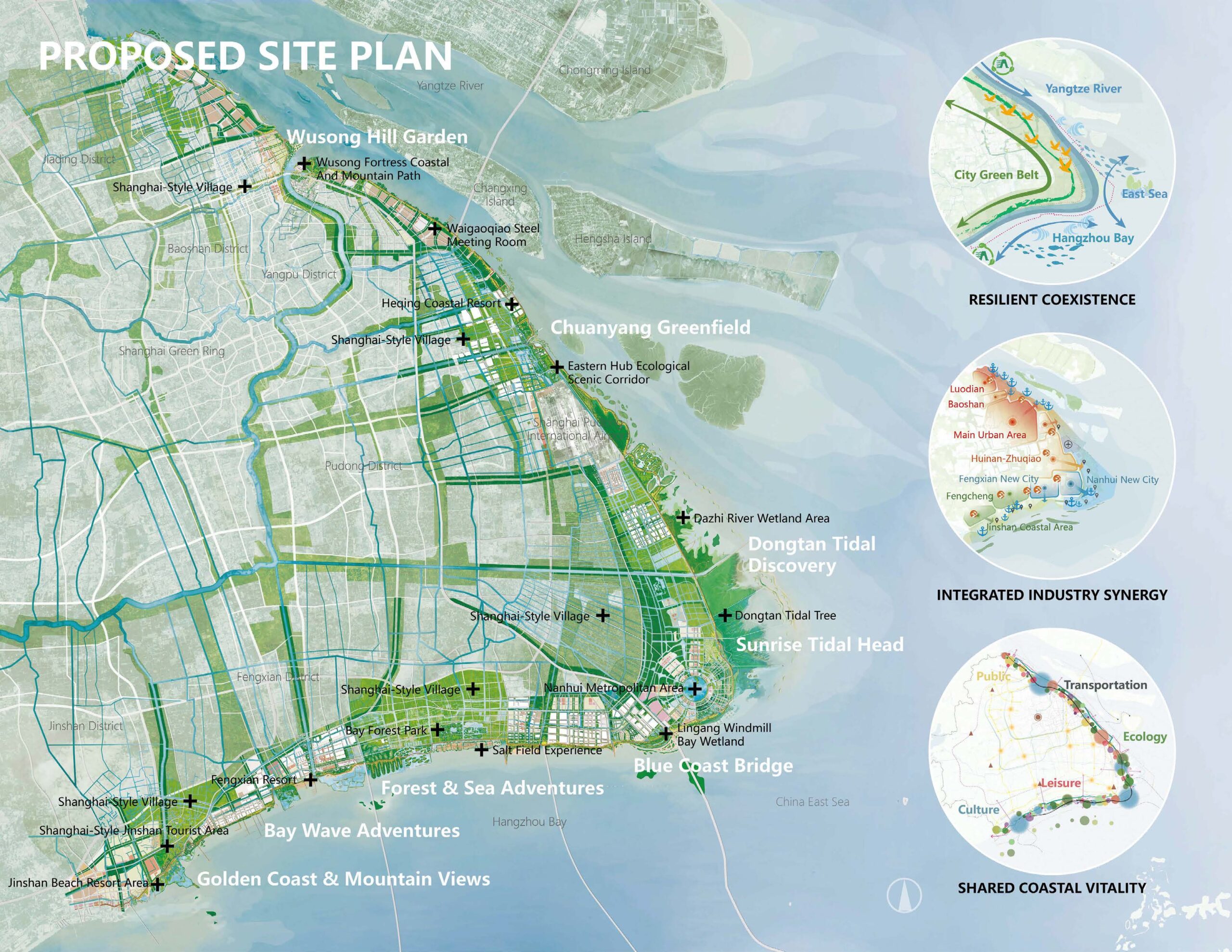
Aerial view – The proposal’s core is the “Living Spine,” a supple landform replacing rigid seawalls. Expanding, rising, and growing through time, this adaptive infrastructure harmonizes robust coastal defense with ecological restoration and sustainable development.
©TLS ©CAUPD
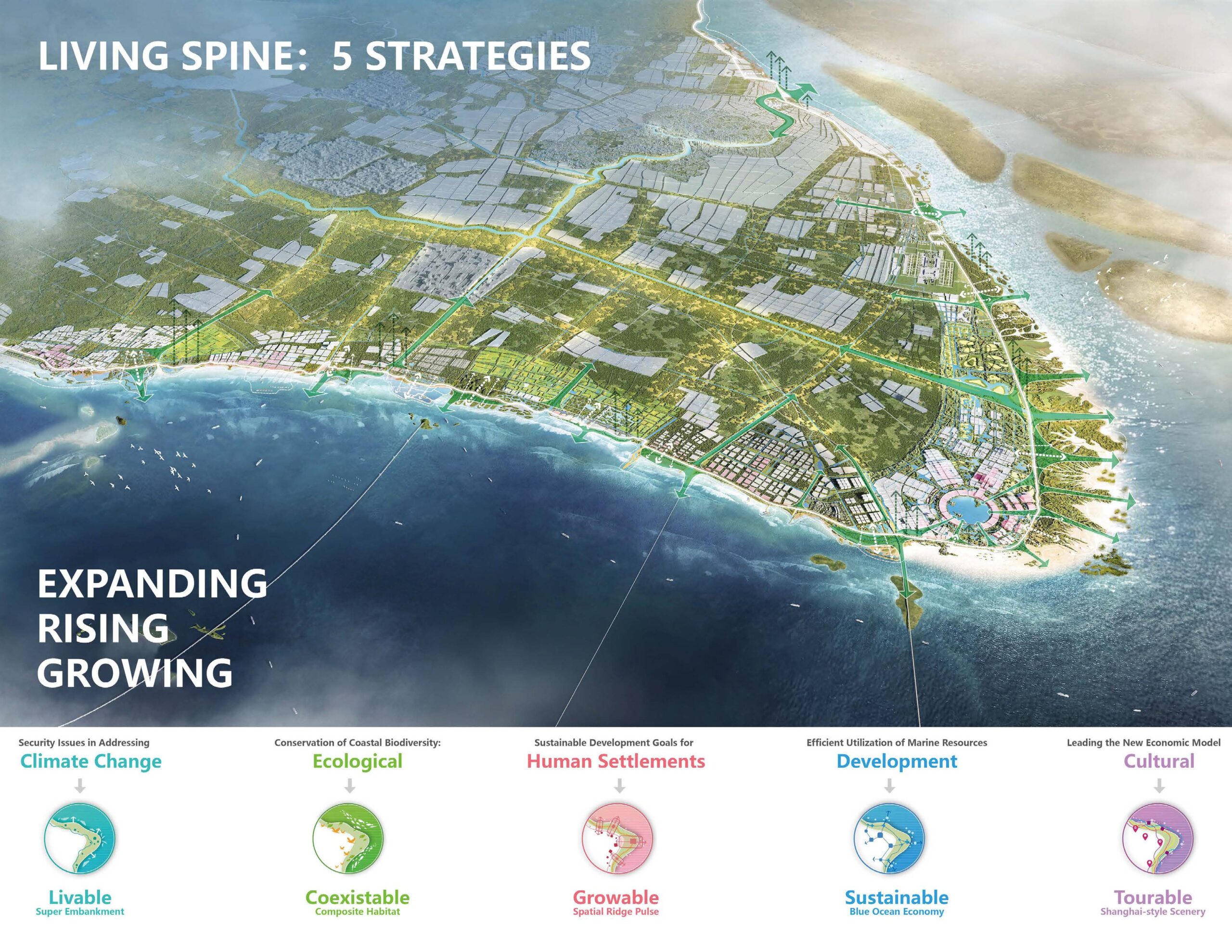
Proposed site plan: Translating strategic goals into spatial reality, the master plan defines specific coastal interventions. It structurally integrates resilient ecological borders, synergistic industries, and shared community landscapes.
©TLS
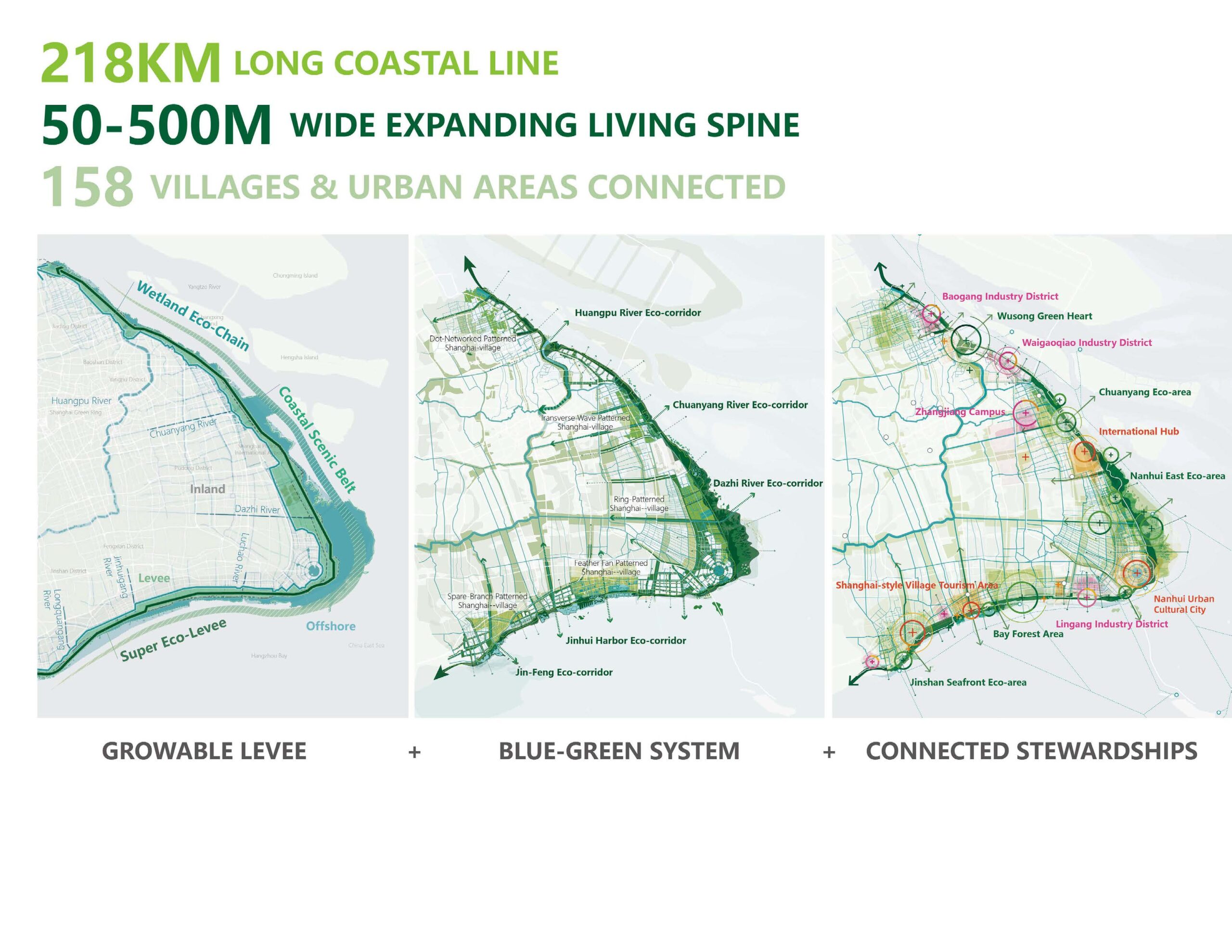
Proposing a paradigm shift toward adaptive symbiosis, this landscape-led framework intricately layers infrastructural, ecological, and social networks. This synthesis redefines coastal protection as a regenerative engine for long-term regional resilience.
Left ©TLS ©CAUPD. Middle & Right ©TLS
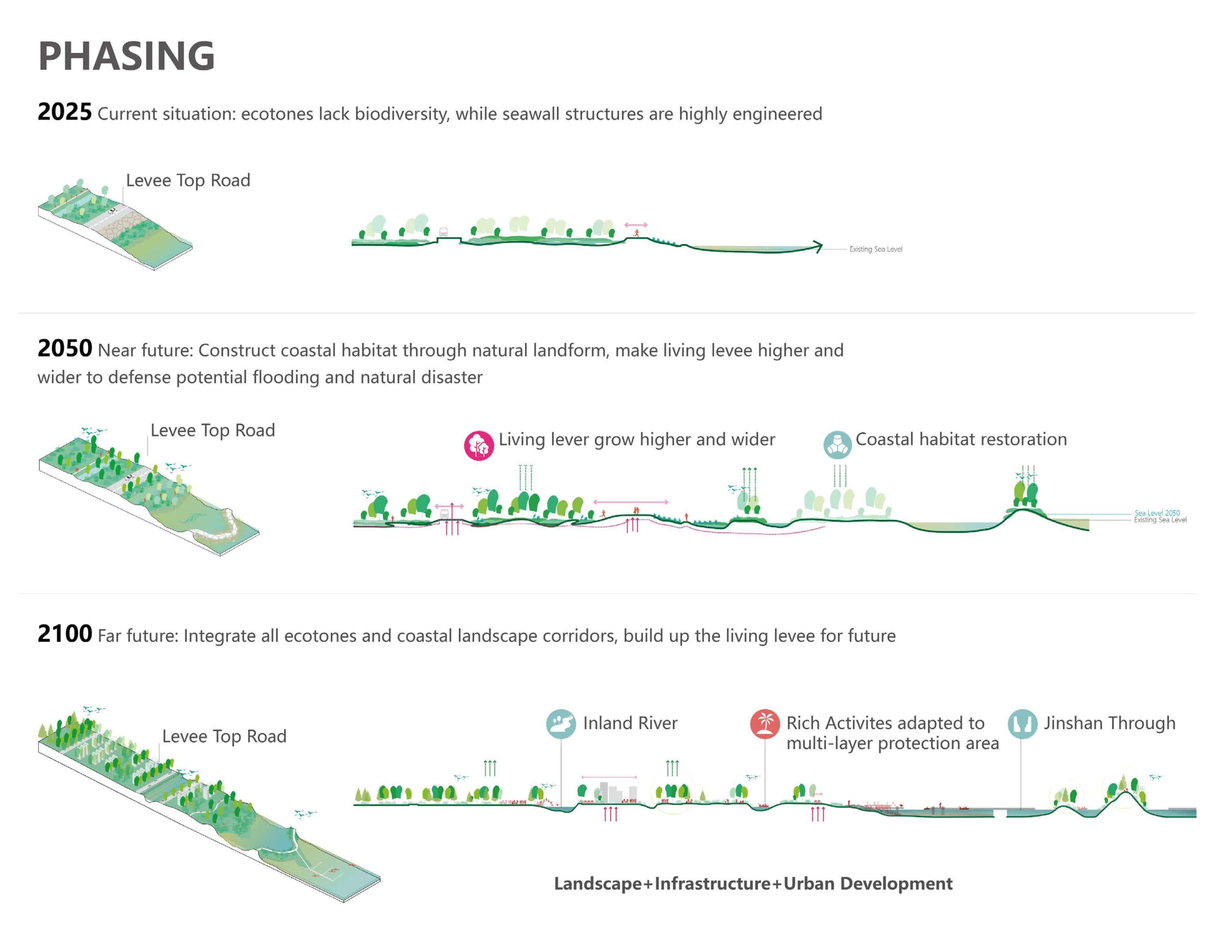
2025, 2050, 2100: Cultivating a higher and wider living levee. This phased implementation advances from near–term ecological retrofitting to the ultimate integration of landscape, infrastructure, and urban development.
©TLS

Native planting communities drive targeted restoration from low tidal wetlands to upland forests. This living gradient transforms the seafront into a vibrant ecosystem, achieving a harmonious balance between robust ecological habitats, human activity, and forward-looking infrastructure.
©TLS
Unlike conventional infrastructure that degrades, the “Living Spine” strengthens through natural processes. By repurposing local materials, the design accelerates ecological succession, transforming the shoreline into a self-sustaining, resilient habitat.
©TLS

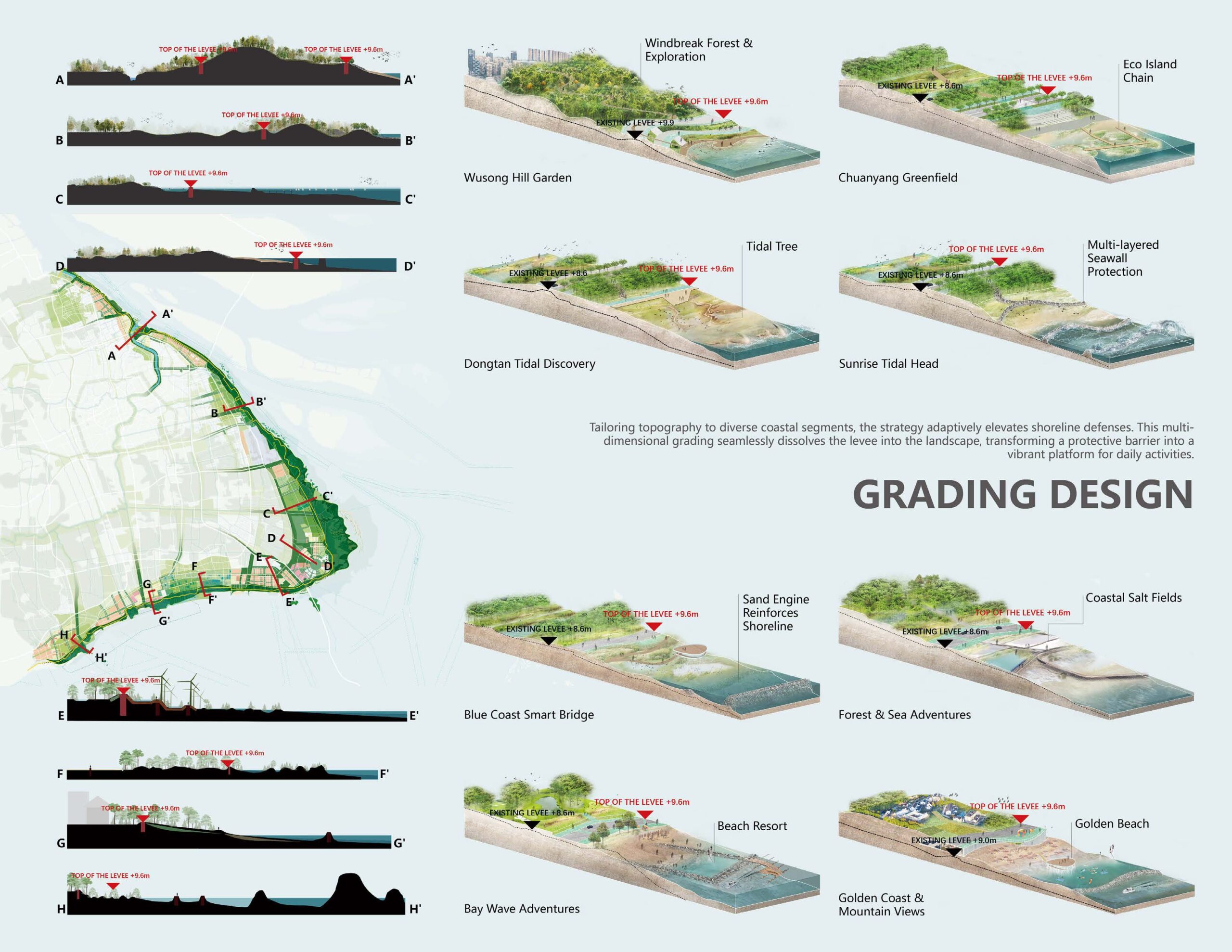
Tailoring topography to diverse coastal segments, the strategy adaptively elevates shoreline defenses. This multi-dimensional grading seamlessly dissolves the levee into the landscape, transforming a protective barrier into a vibrant platform for daily activities.
©TLS
To optimize coastal resilience, hydrodynamic models test diverse off-shore reef configurations to achieve a better sediment-catching and water-breaking effect, supporting the growing of the living spine.
©TLS

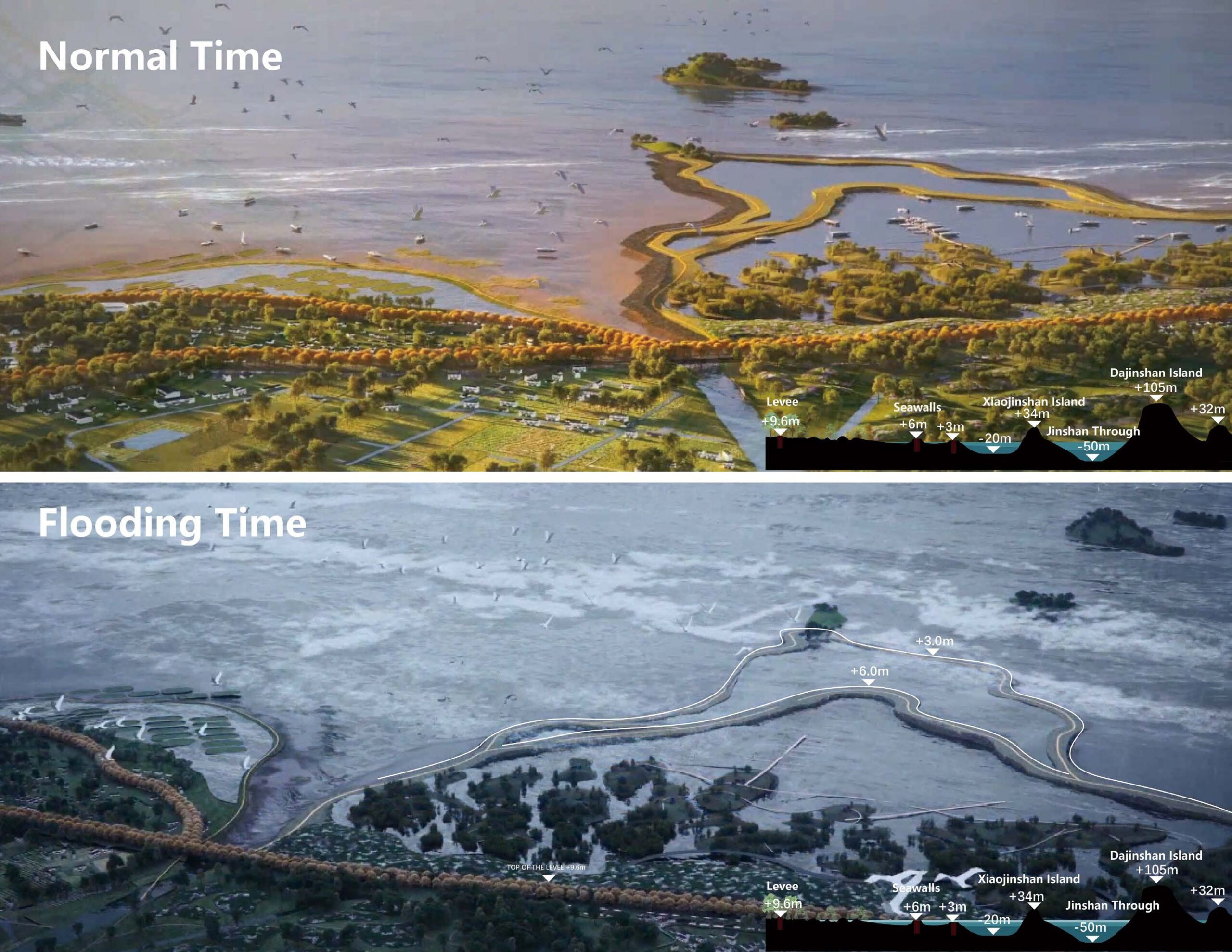
Demonstrating dynamic resilience, the site transitions from a vibrant seafront area during normal conditions to a robust buffer during floods. This multi-layered system safely protects inland areas while maintaining vital infrastructure connections.
©TLS ©CAUPD
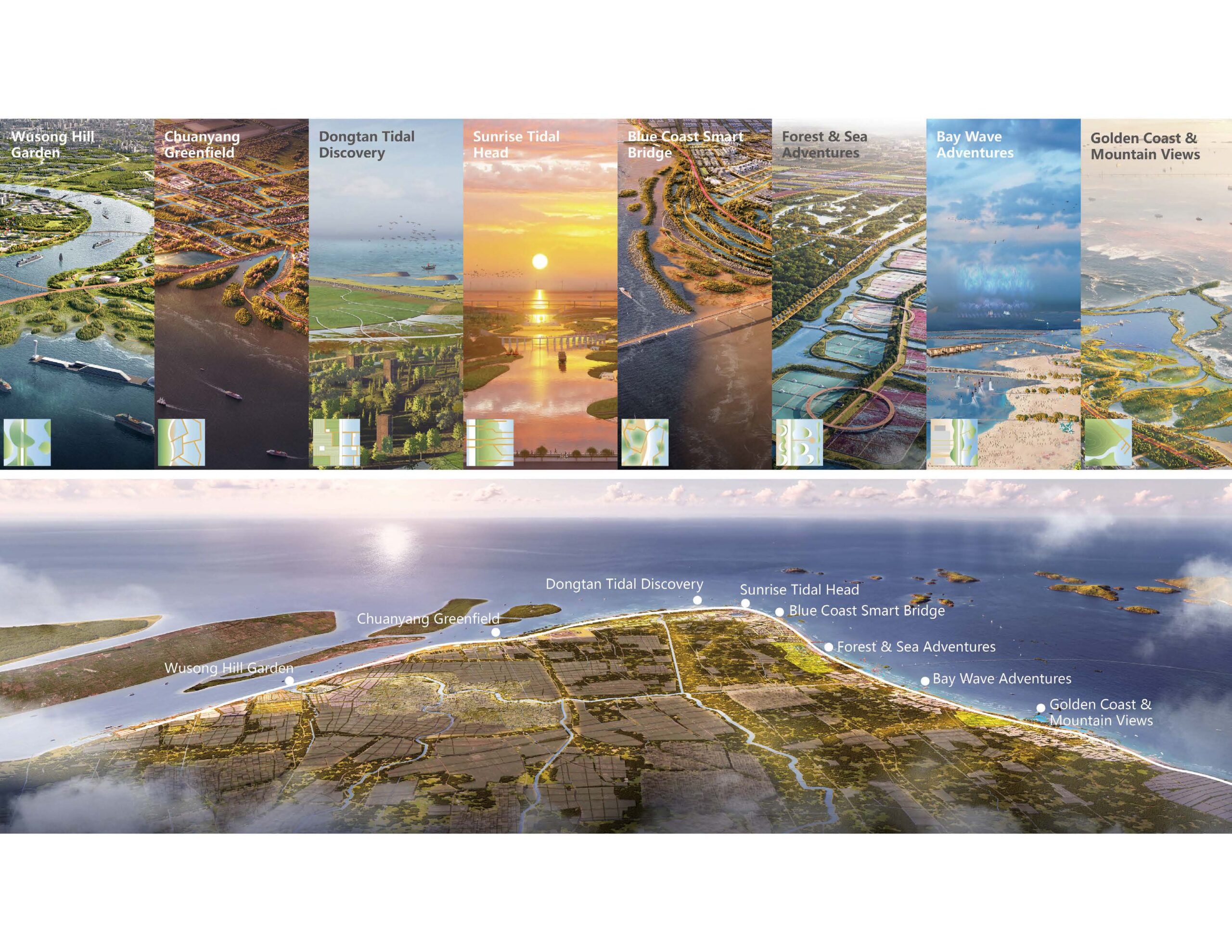
Landward, flood infrastructure transforms into a vibrant civic and economic continuum. Organizing the 218-kilometer coastline into three regions towards different hydrological conditions, the spatial structure leverages eco-corridors to connect distinct coastal strategies with the broader urban fabric.
©TLS
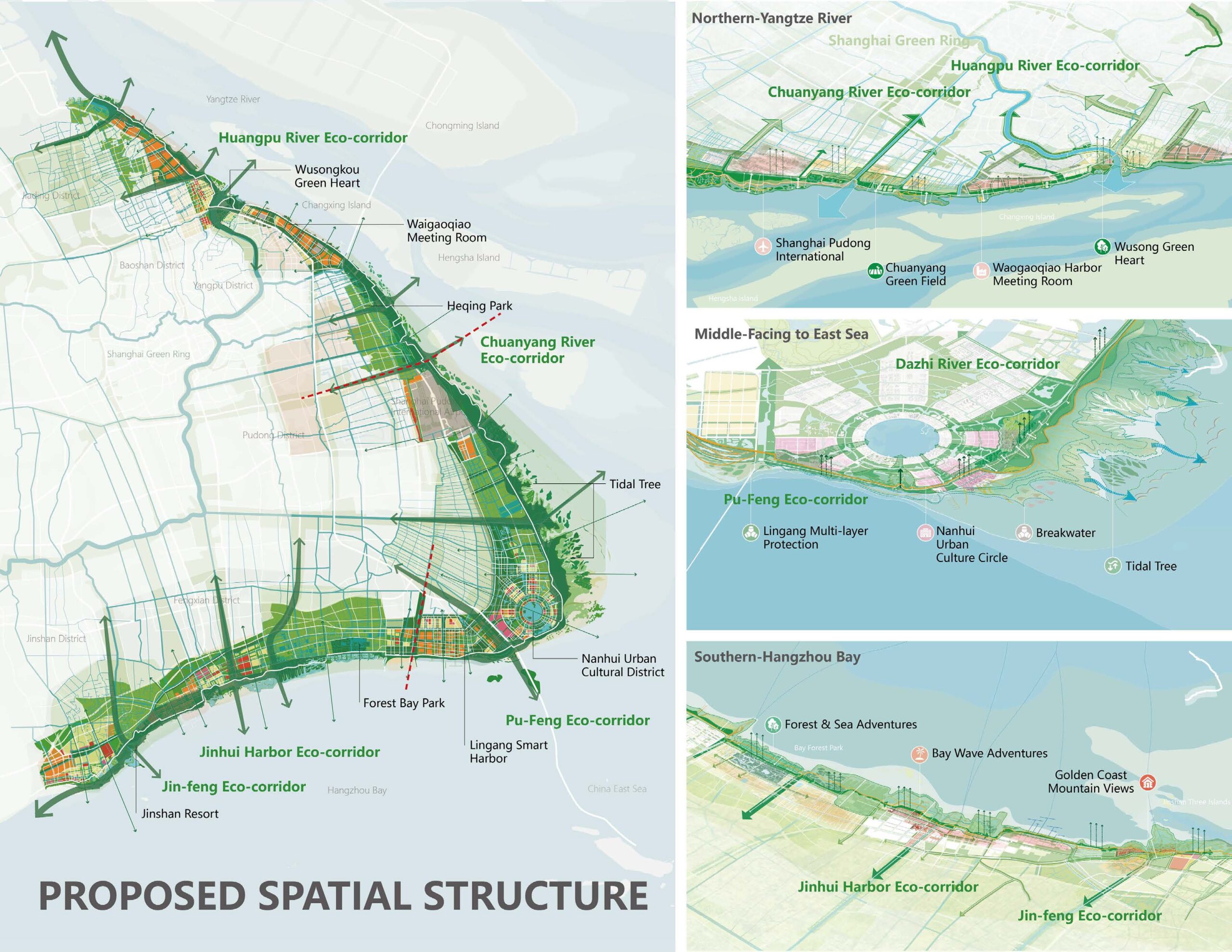
8 key nodes with distinctive features connected through the living spine.
©TLS ©CAUPD
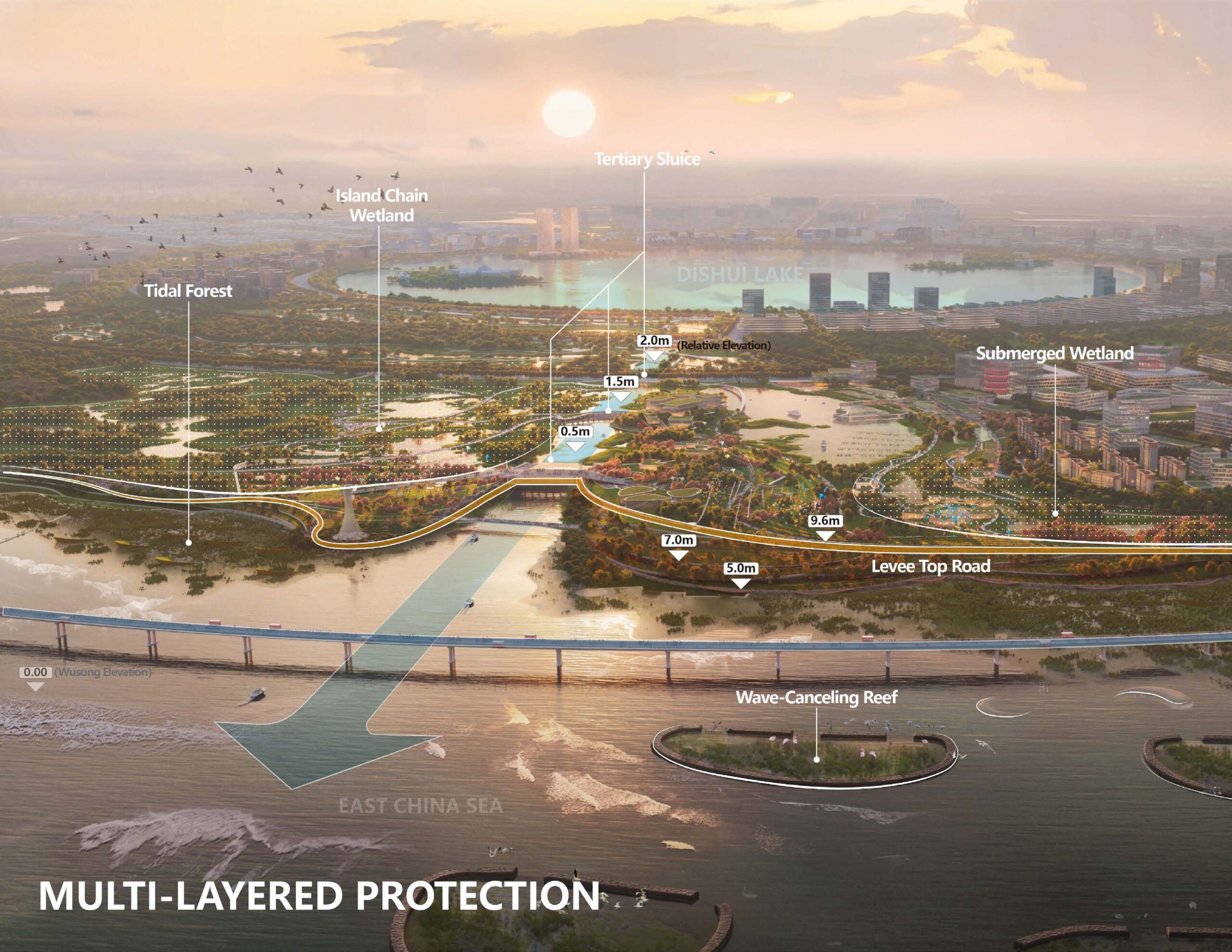
Bridging the Sea and inland, the design establishes a resilient ecological gradient. By integrating wave-canceling reefs, tidal forests, and submerged wetlands, this buffer transforms robust coastal defense into a vibrant urban living circle.
©TLS ©CAUPD
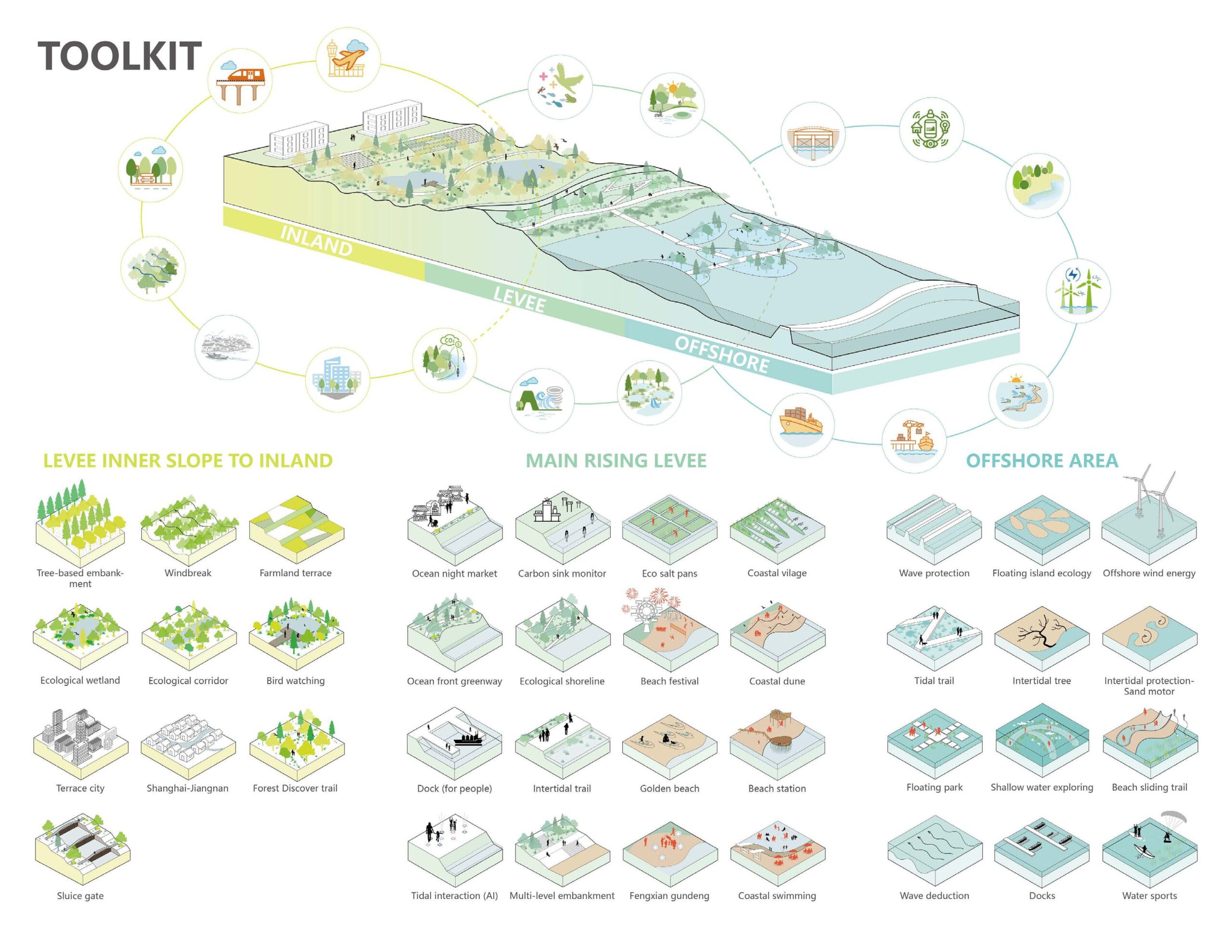
This metabolic infrastructure spans over 210 square kilometers and is organized into a three- layer adaptive defense system supported by a highly versatile toolkit.
©TLS

Integrating tourism, ecology, and agriculture, the “Living Spine” generates a thriving coastal economy.
Top ©TLS. Down ©TLS ©CAUPD
Client
Shanghai Municipal Bureau of Planning and Natural Resources
Project Team
Tom Leader, Lead Landscape Architect
Wanpeng Zu, Lead Landscape Designer and Landscape Project Leader
Landscape Core Team: Jingwei Jiang, Ying Wei, Ying Zhang
Landscape Design Team: Shuping Ye, Yanyao Cui, Mengyao Xing, Yang Yu, Yuwei Zhu, Yao Zhou, Leijing Yang, YiXin Zhou, Nuo Li
Landscape Project Manager: Huan Zheng
Collaborating Companies:
Consortium: China Academy of Urban Planning and Design
Lead Designer: Zhenyu Chen
Lead Urban Designer: Jingbei Han
CAUPD Team
Consulting Company:
Ocean Consultant: Shanghai SICC Engineering Design Co., LTD. afterNature
Rendering and Animation team: EAFIE
Multimedia Company: Eleven Inc.
Physical Model Company: Wenzhu Model Company
Organizer of Solicitation: Beijing Science Park Auction& Tender Co., Ltd
Technical Service Provider: Shanghai Urban Planning & Design Research Institute
Project Statement
Living Spine: A Resilient Vision for Shanghai’s V-Shaped Coastline addresses one of the world’s most complex coastal challenges rapid sea-level rise, land subsidence, sediment depletion, and ecological fragmentation along Shanghai’s 218-kilometer urbanized shoreline.
The project reframes coastal protection as a living, landscape-based planning framework. It replaces rigid concrete seawalls with a Living Levee a supple, resilient landform designed to grow through natural sedimentation, ecological succession, and rising tides. Spanning over 210 km2, the system integrates near–shore super-levees, intertidal filtration landscapes, and offshore biomimetic reef networks into a dynamic Linear City of the Sea.
By harmonizing ancient Gangshen (shell-ridge) heritage with future-oriented climate adaptation, the plan shifts from defensive armoring to active symbiosis-offering a scalable blueprint for coastal megacities to navigate the climate crisis with landscapes that evolve, breathe, and sustain urban life for centuries to come.
Project Description
Living Spine: A Resilient Vision for Shanghai’s V-Shaped Coastline
Shanghai’s V-shaped coastline formed through millennia of Yangtze River sedimentation and human reclamation is both the city’s origin and its frontline. Today, this 218-kilometer urbanized shoreline faces accelerating threats from sea-level rise, land subsidence, sediment depletion, and ecological fragmentation. Existing concrete seawalls and “super dikes,” while effective in the short term, are fundamentally brittle systems built on fixed assumptions of sea level and wave behavior. Projections for 2100 indicate that current protection standards will be insufficient for much of the city. The challenge is not only technical, but spatial, ecological, and civic.
Living Spine proposes a paradigm shift—from static defense to adaptive symbiosis—by reframing coastal protection as a living, landscape-led planning framework. Rather than fortifying a hard edge, the project redefines the coastline as a dynamic system capable of growth, regeneration, and long-term resilience.
The Living Levee: Strategy and Structure
At the core of the plan is the Living Levee, a supple, growing landform that replaces rigid concrete seawalls. Unlike conventional infrastructure that degrades over time, the Living Levee is designed to strengthen through natural processes. By working with the V-shaped coastline’s geomorphology, the system harnesses sedimentation as a construction material. Strategic landform shaping and pioneer vegetation slow water movement, capture suspended silts, and allow the levee to gain height and width as sea levels rise.
This metabolic infrastructure spans over 210 square kilometers and is organized into a three-layer adaptive defense system.
The near–shore Super-Levee raises the overall ground plane, integrating transportation corridors, public parks, and urban development directly into the protective landform, transforming flood defense into inhabitable civic space.
The intertidal Filtration Zone composed of wetlands, salt marshes, dunes, and tidal flats- functions as a biological shock absorber that dissipates wave energy, filters urban runoff, and supports ecological succession.
Further offshore, biomimetic reefs and island chains attenuate storm surges before they reach the mainland, creating calm waters that support marine biodiversity and long-term ecological restoration.
Together, these layers transform a static barrier into a Linear City of the Sea a continuous coastal system that protects, produces, and evolves.
Living with Time, Sediment, and Culture
Rather than resisting natural processes, the plan leverages sedimentation as a long-term growth mechanism. The coastline is designed to migrate gradually seaward through managed accretion, allowing landforms and ecosystems to expand over decades and centuries–extending relevance beyond conventional engineering lifespans.
Culturally, the project weaves climate adaptation with Shanghai’s deep coastal memory. Ancient Gangshen (shell-ridge) landscapes and historic seawall narratives are reinterpreted as part of a contemporary ecological armature, grounding future resilience in regional identity.
The Coastal Symphony: Public Life and Regional Structure
Landward, flood infrastructure is transformed into a civic and economic continuum. The 218- kilometer coastline is organized into three regional “movements” with distinct spatial strategies. In Hangzhou Bay, restored shell ridges, fishing villages, and resilient “sea-cliff” communities reconnect cultural heritage with ecological restoration.
Along the East China Sea, centered on Nanhui as the “Apex of the Spine,” offshore wind energy, smart tidal monitoring, and blue-tech industries form a high-performance innovation coast. At the Yangtze River Estuary, large-scale sediment capture supports the creation of future ecological islands, establishing a regional sanctuary for biodiversity and flood mitigation.
Implementation, Sustainability, and Impact
The plan follows a phased implementation strategy: near-term ecological retrofitting and soil reuse; mid-term development of the three-layer Living Spine and key urban interfaces; and long-term formation of offshore island chains. Large volumes of urban excavation soil and Yangtze sediments are repurposed as primary building materials, transforming a major metropolitan waste stream into a long-term ecological and infrastructural asset.
By transforming coastal protection from a maintenance burden into a regenerative asset, Living Spine offers a scalable model for global coastal megacities. It demonstrates how landscape architecture can lead the integration of climate resilience, ecosystem restoration, and public life- ensuring that Shanghai does not merely survive rising seas, but evolves with them.