
Aerial view of Esprit Park within San Francisco’s Dogpatch neighborhood, and its relationship to adjacent residential blocks, UCSF campus, and regional infrastructure along the Central Waterfront.
©Bruce Damonte

3D aerial plan of Esprit Park. The Esprit Park Renovation transforms a beloved 2.4-acre Dogpatch neighborhood park into a cohesive, ecologically vibrant urban commons.
©Fletcher Studio

Overhead view of Esprit Park shows a sinuous accessible loop connecting two distinct meadows (one dedicated to dogs and the other to families), nature-inspired exercise stations, and dispersed picnic and seating areas.
©Bruce Damonte

View across Esprit Park’s south meadow, where sinuous circulation, layered planting, preserved redwoods, and flexible gathering spaces come together to create an inclusive, ecologically grounded neighborhood landscape within San Francisco’s urban fabric.
©Bruce Damonte

Evening circulation through Esprit Park’s redwood grove, where meandering paths and warm catenary lighting weave together, creating a safe, inviting atmosphere that extends neighborhood life into the night.
©Bruce Damonte
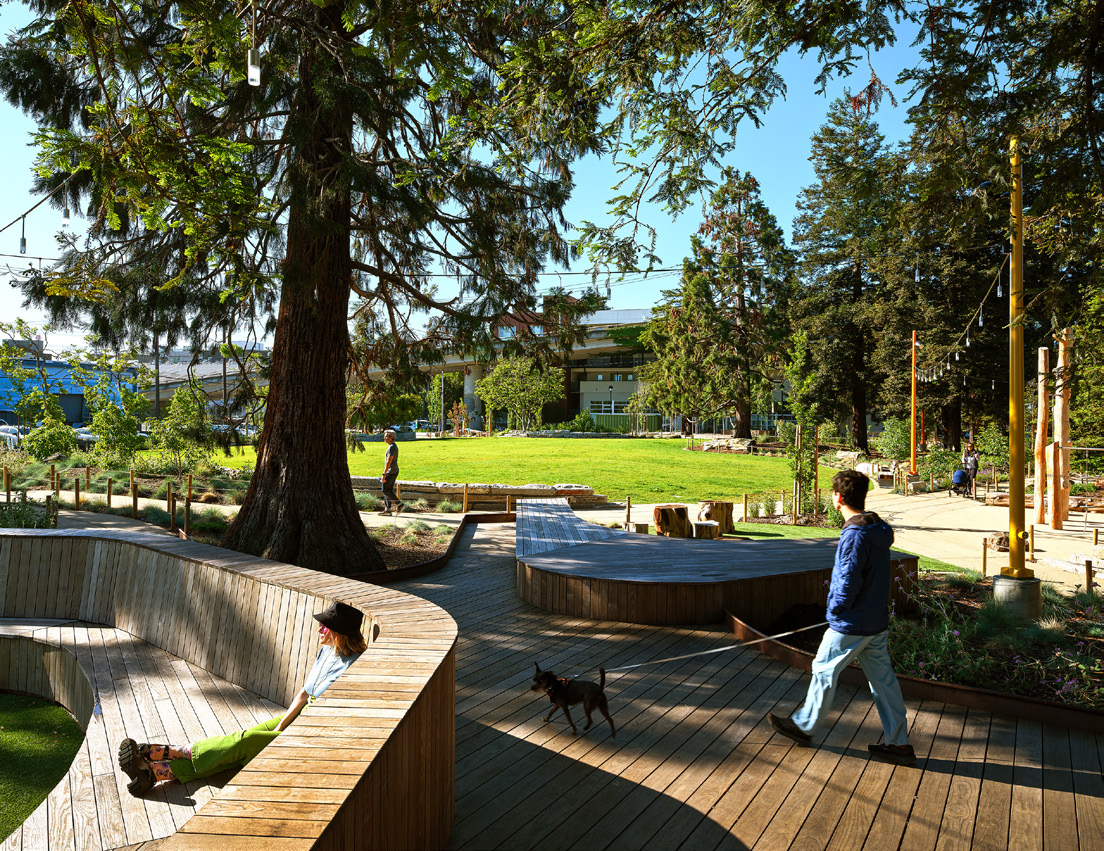
Curving wood platforms embrace mature redwoods, creating intimate seating and accessible pathways that connect meadow, exercise stations, and daily park life—where neighbors relax, stroll with dogs, and gather.
©Bruce Damonte

Elevated wood platforms wrap around and integrate existing trees, protecting root zones while creating flexible seating, gathering, and play spaces that bring visitors into close connection with Esprit Park’s mature urban forest.
©Bruce Damonte

The off-leash dog meadow incorporates natural and synthetic turf areas for pups to enjoy, while owners can relax at the adjacent wood deck seating or plaza picnic area.
©Bruce Damonte, SPEC Play

Twilight at Esprit Park: warm catenary lights glow beneath the redwoods as neighbors gather on sculpted wood platforms, children play, and robinia timber exercise stations invite movement, transforming the park into a welcoming, luminous neighborhood commons after dark.
©SPEC PLAY

Under the canopy of mature redwoods, an elevated wood platform weaves gently through the grove, protecting roots while inviting neighbors to linger, gather, and enjoy the warm glow of evening light.
©Bruce Damonte

Five exercise stations constructed from durable Robinia timber are distributed along the pedestrian loop. Designed as sculptural elements, they reinforce the park’s material language while encouraging intergenerational movement and informal play.
©Bruce Damonte

The entry to the North Meadow. It acts as an off leash dog park, with natural turf one half and artificial turf on the other half.
©Bruce Damonte

A second wood platform at the southern edge of the park integrates new poplar trees into the structure itself. Composed of two tiers, the platform provides flexible seating configurations that support small gatherings, informal performances, and everyday park use.
©Bruce Damonte
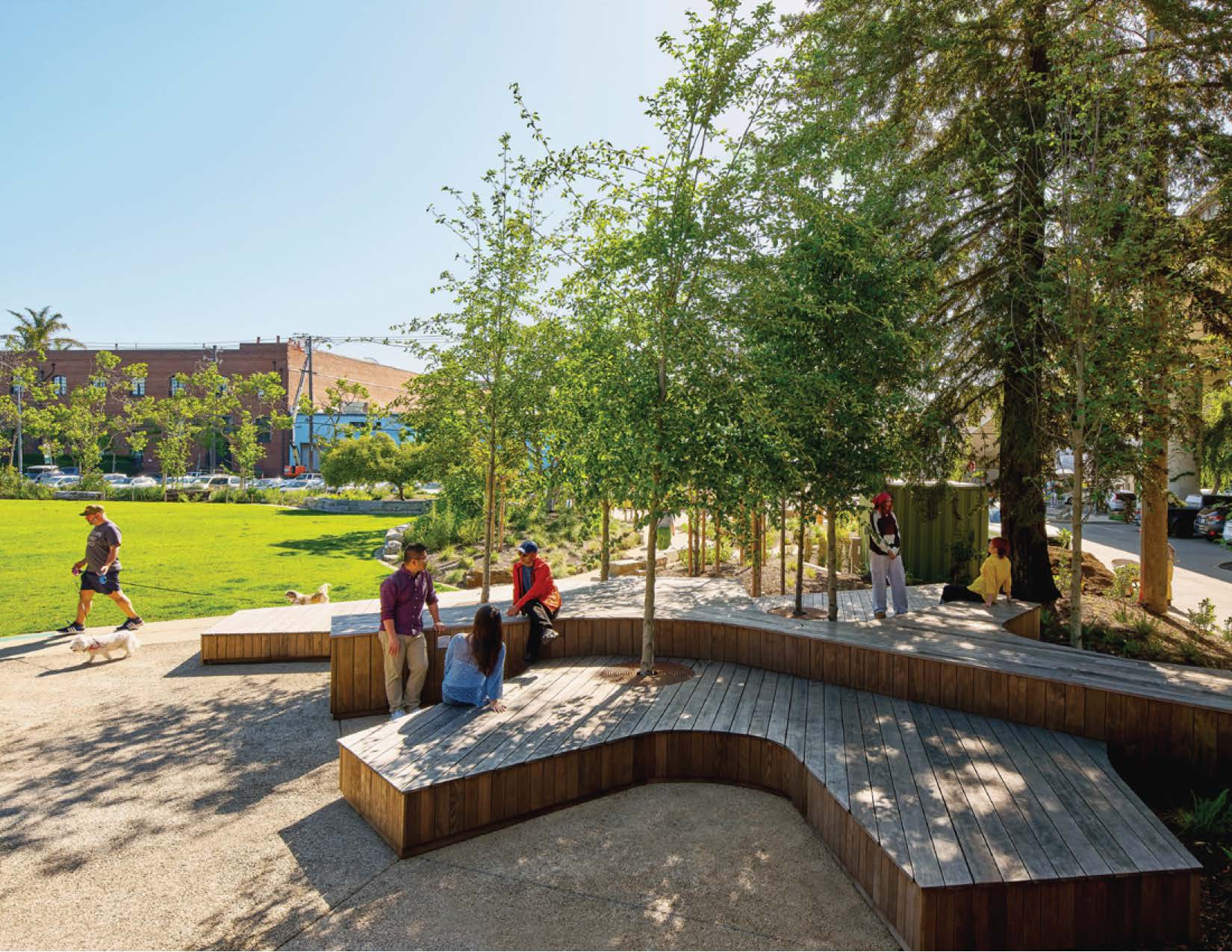
The elevated stage and platform is planted with native Alders.
©SPEC Play

Esprit Park reimagines a beloved neighborhood green as a resilient urban commons, preserving mature redwoods, restoring habitat, and weaving inclusive gathering spaces into the city fabric for generations to come.
©Bruce Damonte
Client
San Francisco Recreation and Parks
Project Team
David Fletcher, Project Manager and Design Lead
San Francisco Recreation and Parks
The Green Benefit District
University of California San Francisco
BKF Engineers, Civil Engineer
Russel D Mitchell and Associates, Irrigation Designer
Vektor Engineering, Electrical Engineer
Hohbach Lewin, Structural Engineer
Joe Chambers Art and Design, Metalwork
Bauman, General Contractor
Catmex, Landscape Contractor
SPEC Play, Exercise Equipment
Project Statement
The Esprit Park Renovation transforms a beloved 2.4-acre Dogpatch neighborhood park into a cohesive, ecologically vibrant urban commons. Through an inclusive community-driven process, the design resolves long-standing conflicts between active and passive uses while preserving a grove of 60+ year old redwoods. A sinuous accessible loop connects two distinct meadows (one dedicated to dogs and the other to families), nature-inspired exercise stations, and dispersed picnic and seating areas. Two elevated tree protection platforms guide human engagement with the mature redwoods and a new grove of poplars. Reclaimed granite curbs form site retaining walls and salvaged redwood trunks left in-situ reinforce the park’s climate action and carbon drawdown goals, while native planting and custom bird houses enhance biodiversity. Overhead catenary lighting balances safety while enhancing the forest-like atmosphere. The result is an inclusive, materially grounded and ecologically rich public landscape that strengthens community life and extends the park’s legacy.
Project Description
The transformation of Esprit Park reflects a sustained partnership between a dedicated local community, UCSF, the San Francisco Recreation & Parks Department (SFRPD), and the Green Benefit District (GBD). Fletcher Studio led a public engagement process over a period of three years to shape a shared vision that responds to contemporary recreational needs while preserving the existing urban forest.
Originally constructed in the 1980s, the park was designed as part of an urban oasis campus for the employees of the Esprit clothing corporation, which was headquartered on the park’s east side. Circulation was disconnected, program areas overlapped, and ecological systems were neglected. The renovation reestablishes spatial clarity, enhances habitat value, and introduces a mix of seating and picnic spaces that serve a diverse and growing population.
An accessible pathway around the site’s perimeter provides the park with much needed structure, connecting previously disjointed areas. Two distinct meadow zones one designated for off-leash dogs and one for families resolve long-standing user conflicts and support varied modes of recreation. Expanded picnic areas, upgraded exercise stations, and two signature wood platforms create opportunities for gathering, play, and rest.
At the heart of the park, an organically shaped wood platform winds its way through a grove of mature redwoods, allowing visitors to engage closely with these iconic trees while protecting sensitive root zones. The elevated platform is accessed via sloped walkways, and a railing-height divider maintains safety while framing views into the dog meadow. This intervention transforms a previously underutilized grove into a new, dynamic gathering spot.
A second platform at the southern edge integrates new poplar trees into the structure itself. Openings for the trunks are created with flush metal tree grates, which can expand as the trees grow to accommodate widening trunks. Composed of two tiers of angled wood planks, the platform provides flexible seating configurations that support small gatherings, informal performances, and everyday park use.
Five exercise stations constructed from durable Robinia timber are distributed along the pedestrian loop. Designed as sculptural elements, they reinforce the park’s material language while encouraging intergenerational movement and informal play.
Material reuse is central to the renovation of Esprit Park. Reclaimed granite curbs act as low, stacked walls, while salvaged site trees have been crafted into timber logs. Together they retain grade transitions and provide informal seating throughout the site. These elements reduce waste, support soil stability, and contribute to a cohesive landscape expression rooted in local material history.
Lighting improvements enhance safety while preserving the park’s intimate nighttime character. Motion-sensor pathway lights provide focused illumination. Catenary lighting is woven through the tree canopy and colorful light poles are situated along the forest edge, creating a warm, welcoming atmosphere without overwhelming the park’s natural elements.
California native planting strengthens ecological performance and seasonal experience. The planting palette emphasizes drought-tolerant species and pollinator-supporting perennials, providing year-round texture and habitat value. Seasonal blooms attract butterflies, bees, and hummingbirds, while stacked clusters of bird houses offer nesting opportunities for multiple species, serving as a distinctive design feature within the landscape.
Today, Esprit Park operates as a cohesive neighborhood commons that balances active recreation with quiet refuge, ecological restoration with social vitality. The renovation preserves the park’s historic character while positioning it as a resilient, inclusive public space for decades to come.