

Stockton: Where extreme heat meets unequal burden
© Yanyao Cui
Heat disparities in Stockton
© Yanyao Cui

Visualizing heat risk at popular children’s activity locations in the Kennedy community
© Yanyao Cui
Cooling the future: a children-centered cooling network
© Yanyao Cui

Cooling the future: toolkits for cooling network
© Yanyao Cui
From idea to impact: two cooling prototypes for children in Kennedy
© Yanyao Cui

Cooling in action: prototype implementations at site 1
© Yanyao Cui

Cooling in action: cooling evaluation using before-and-after simulations for site 1
© Yanyao Cui

Cooling in action: detailed implements
© Yanyao Cui

Cooling in action: prototype implementation at site 2
© Yanyao Cui

Cooling in action: cooling evaluation using before-and-after simulations for site 2
© Yanyao Cui

Cooling in action: detailed implements
© Yanyao Cui

Final exhibit and presentation
© Yanyao Cui
Client
UC Berkeley
Project Team
Yanyao Cui, MLA Student Landscape Architecture
Committee Members: Chip Sullivan, Louise Mozingo, Richard Hindle, Huizhang
Project Statement
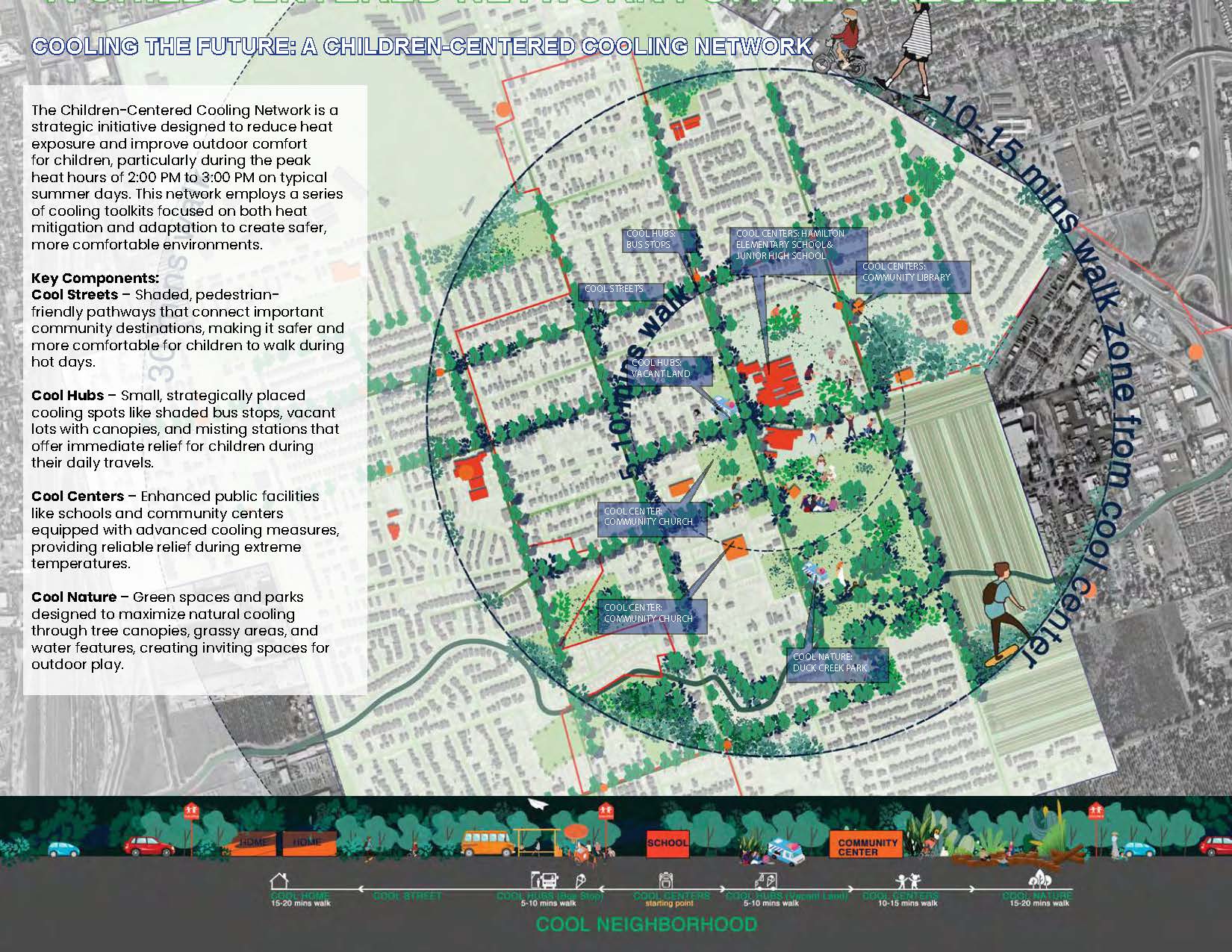
Outdoor time is vital for children’s development, yet physical activity remains low globally, particularly in marginalized communities in heat-vulnerable zones. Early exposure to extreme temperatures has lasting health impacts, especially during critical brain development. Children of color are disproportionately affected by rising temperatures and heat events. Despite these risks, urban heat strategies often overlook children’s needs. This research emphasizes child-centered cooling strategies that consider key routes, public spaces, walking distances, and flexible interventions tailored to diverse scenarios. Prioritizing low-income neighborhoods can reduce vulnerabilities and promote safer outdoor play.
Project Description
Stockton’s Heat Vulnerability and Child-Centered Cooling Network
Stockton, located in California’s Central Valley, experiences extreme summer temperatures— averaging 20°F higher than San Francisco and Berkeley-due to surrounding ridges that block coastal air. Climate change has worsened these conditions, with days over 100°F increasing from 7 days in 1990 to 40 days in 2022 and 49 days in 2024, reaching a record-high of 115°F in September 2022.
Heat Disparities in Stockton
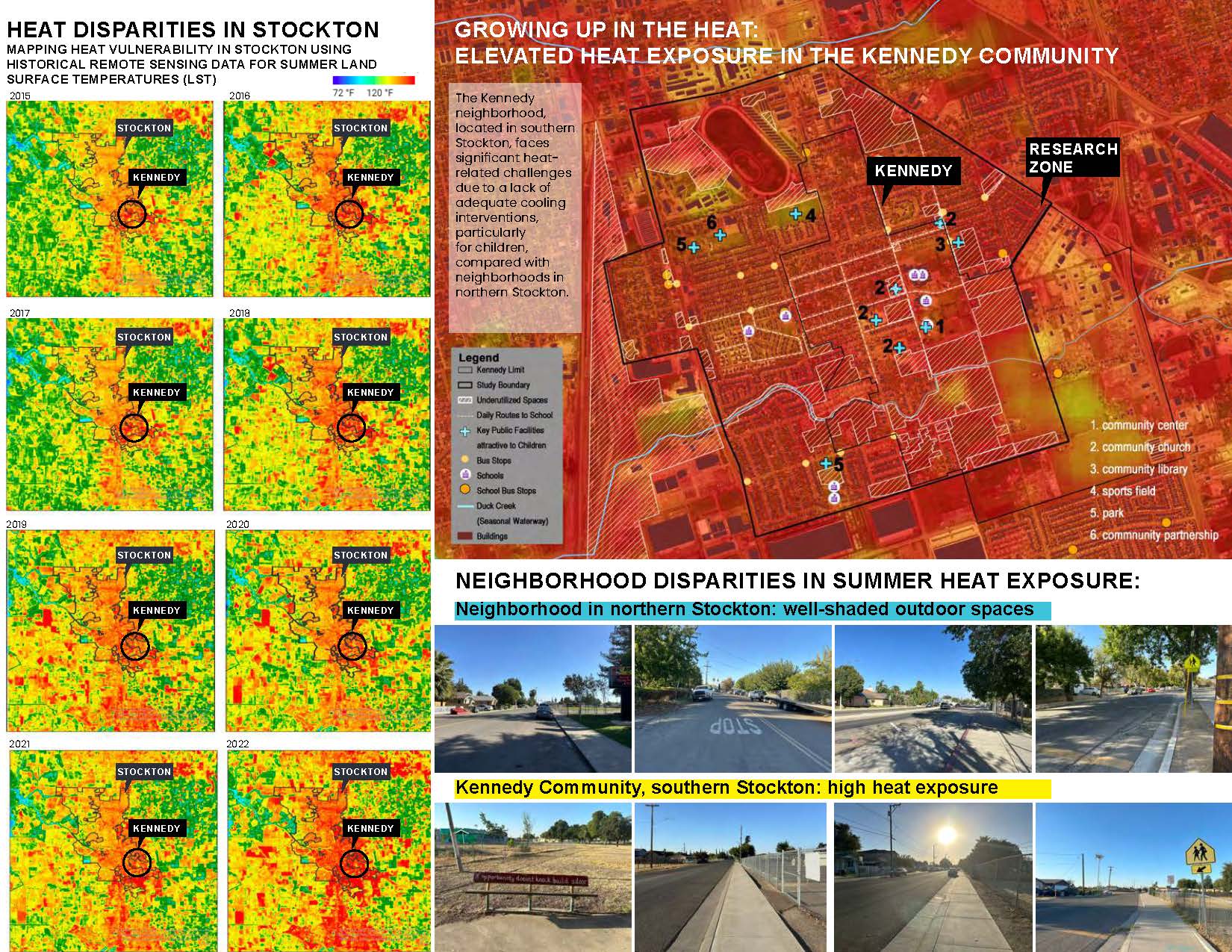
Heat vulnerability is starkly divided between Stockton’s northern and southern regions. Analysis of average land surface temperatures (LST) from 2015 to 2022, using historical remote sensing data, reveals that southern Stockton-home to larger populations of disadvantaged communities and children consistently faces higher temperatures. This disparity heightens health risks for marginalized children, contributing to immediate physical discomfort and long-term developmental challenges.
The Kennedy neighborhood, located in southern Stockton, exemplifies these challenges. About 60% of its land use is residential, 20% is industrial, and much remains underutilized. One-third of its population consists of children, with 45% living in poverty, predominantly from non-white families. This community lacks critical cooling infrastructure-such as tree canopies and shaded pathways-while impervious surfaces and barren soil contribute to elevated temperatures. Key routes to schools and public facilities like community centers, libraries, and churches are in high-heat zones, making daily travel and outdoor play dangerous for children.