
World Alum Mining Town Core Area Planning
Merit Award /
2026, International Project
Fanshan Town, Cangnan County, Wenzhou, Zhejiang, China

The Challenge of Post-Extraction
After the depletion of mining resources, how can Fanshan Town achieve industrial transition through heritage revitalization?
©TLS

A Framework for Transition
To respond to this challenge, the project advances three interrelated strategic moves.
©TLS

Overall Plan
A future vision of the town shaped by mine-driven transformation.
©TLS

Cave-Mountain Sectional Relationship.
©TLS

Evoking Impression
Through point–cloud surveying and spatial mapping, the complex cave system is translated into legible spatial hierarchies.
©TLS

Existing Cave System Conditions
The cave network is defined by nonlinear geometry, layered spatial sequences, and dramatic shifts in scale. A comprehensive digital survey and Field exploration, translated into three- dimensional models, makes this complexity legible and supports evidence-based decision- making.
©TLS

Access & Intervention Suitability Map
Assessment of stability, access, and openness defines priority openings, guiding phased expansion from the entrance into deeper chambers.
©TLS

Phasing Program
Based on assessments of openness and the spatial morphology of the mine, cultural, ecological, educational, and small–scale commercial programs are introduced in phases, enabling the cave to evolve into a sustainable public system.
©TLS

Cave Entrance
Through a sustainable systems framework, the mine caves are transformed into an integral part of community life.
©TLS

Cultural Tunnel
The tunnel operates as a cultural capsule where layered interpretations make the history of alum mining visible, transforming movement into an encounter with labor, memory, and time.
©TLS

Fungus Garden
Enabled by the cave’s stable microclimate, the fungus garden is dedicated to fostering experiential curiosity and public science communication, while it can be integrated with dining and supporting amenities to reach a broader audience.
©TLS

Aeroponic Planting
The spacious, level goaf areas are adapted for aeroponic planting, leveraging the mine’s stable microclimate, aligned with research and education through partnerships with nearby universities and schools, linking experimentation to emerging green economies.
©TLS
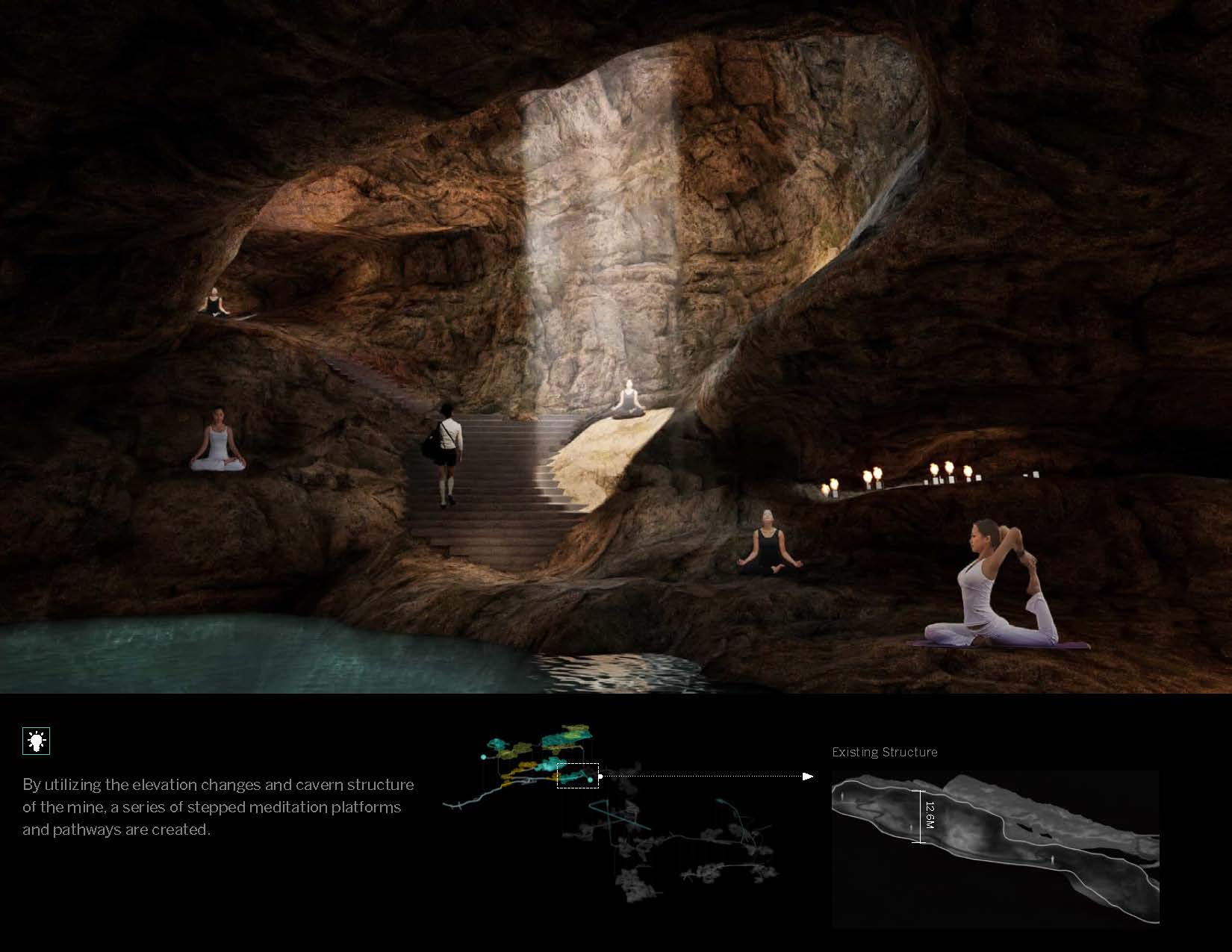
Meditation Platforms
By utilizing the elevation changes and cavern structure of the mine, a series of stepped meditation platforms and pathways are created.
©TLS

Shadow Interaction
A sloping space with a clear winding upward path guides visitors through projection-based shadow theater interactions with “ghost” miners, offering an immersive experience of mining life and spirit.
©TLS

Art Capsule
The mine’s sloping ceiling forms an immersive “art capsule” gallery displaying global cave murals across history, illustrated here by a glowing Shan Hai Jing-themed artwork.
©TLS
Client
Cangnan County Government, Fanshan Town Government, Wenzhou Alum Mining Culture and Tourism Group, Guizhou Zhongshun Stone Development Co.
Project Team
Lead Landscape Architect: Tom Leader
Project Managers: Huan Zheng and Mengyao Xing
Lead Designer: Jiawen Chen
Design Team: Shanshan Bai, Yushan Li, Wei Fan, Zhuo Jiang, Yang Yu, Jingwen Han
Tourism & Business Analysis: Cushman & Wakefield
Architecture Design: PURE Architects
Project Statement
This project reimagines an abandoned underground mine system left by resource depletion as a catalyst for social, cultural, and economic renewal, transforming it into public infrastructure for town revitalization. Through phased, low-impact interventions and operational-readiness controls, a three-criteria evaluation— structural stability, location accessibility, and spatial openness-establishes an actionable opening sequence. Public circulation and heritage interpretation start at the entrance and stable core zones, then expand into deeper chambers for cultural and artistic activities, study tours and education, research experiments, and ecological production spaces. In a safe, incremental, and replicable manner, the proposal converts industrial remnants from a closed production system into shared public assets, creating opportunities for employment, education, and cultural exchange, and guiding post-extractive communities from decline toward resilience long-term.
Project Description
The Challenge of Post-Extraction
Once a mining-driven industrial community, Fanshan now faces economic decline following the depletion of its mineral resources. The abandoned mine cave network, as a remnant of the extractive economy, once sustained local identity and livelihoods, yet today it remains physically isolated and disconnected from everyday civic life.
A Framework for Transition
To respond to this challenge, the project advances three interrelated strategic moves. First, by improving safety conditions and organizing circulation systems, the mine shifts from a closed production space into a public environment accessible for collective experience. Second, the cave system is repositioned as a regional connective structure, linking mountains, communities, heritage nodes, and transportation networks, transforming it from an isolated relic into a framework that organizes relationships between the town and its landscape. As accessibility and operational capacity increase, new programs are gradually introduced: cultural and artistic activities, education, research, and ecological production unfold in sequence, guiding the local economy toward diversification and long-term resilience.
Phasing
This transformation is not immediate. Formed through centuries of extraction, the cave network is defined by nonlinear geometry, layered spatial sequences, and dramatic shifts in scale-conditions that demand incremental occupation. Progress therefore relies on continuous calibration of spatial readiness. A comprehensive digital survey and Field exploration, translated into three-dimensional models, makes this complexity legible and supports evidence-based decision-making. By evaluating structural stability, accessibility, and openness, the proposal establishes priority zones and a phased sequence extending from the entrance toward deeper chambers. Within this structure, cavern environments assume differentiated civic roles. Entrance areas provide orientation and heritage interpretation, while stable, appropriately scaled spaces support exhibitions and educational programs. Controlled cultivation systems—including fungi and aeroponic laboratories enabled by the cave’ s stable climate-convert historic extraction into contemporary knowledge production and a green economy. The project preserves the mine‘ s authenticity, allowing darkness and uncertainty to drive the spatial narrative. By introducing diverse experiences-cultural exhibitions, ecological experiments, and immersive interactions-it transforms the underground from a singular industrial relic into a multifaceted pubic space that integrates culture, science, and nature. Through these experiences, visitors gradually perceive the value of mining civilization and the unique character of the cave system.
A Model Beyond Fanshan
Through alignment between spatial readiness and operational capacity, the abandoned mine becomes adaptive public infrastructure and a long-term engine for urban regeneration. More importantly, the project establishes a transferable framework that moves from risk containment to civic activation, and from industrial legacy to new productivity. It redefines post-extractive landscapes-not as preserved remnants of the past, but as evolving systems capable of generating social, cultural, and economic futures.

