
Ashland Zócalo anchors East 14th Street as the beating heart of a previously underserved community, providing a place to gather and recreate.
©Cesar Rubio Photography

The concept site plan shows how the site was organized to fit a lot into a compact site, featuring a diagonal axis that highlights the shade structure at the intersection, aligned with the lawn, and anchored by the stage.
©Cesar Rubio Photography
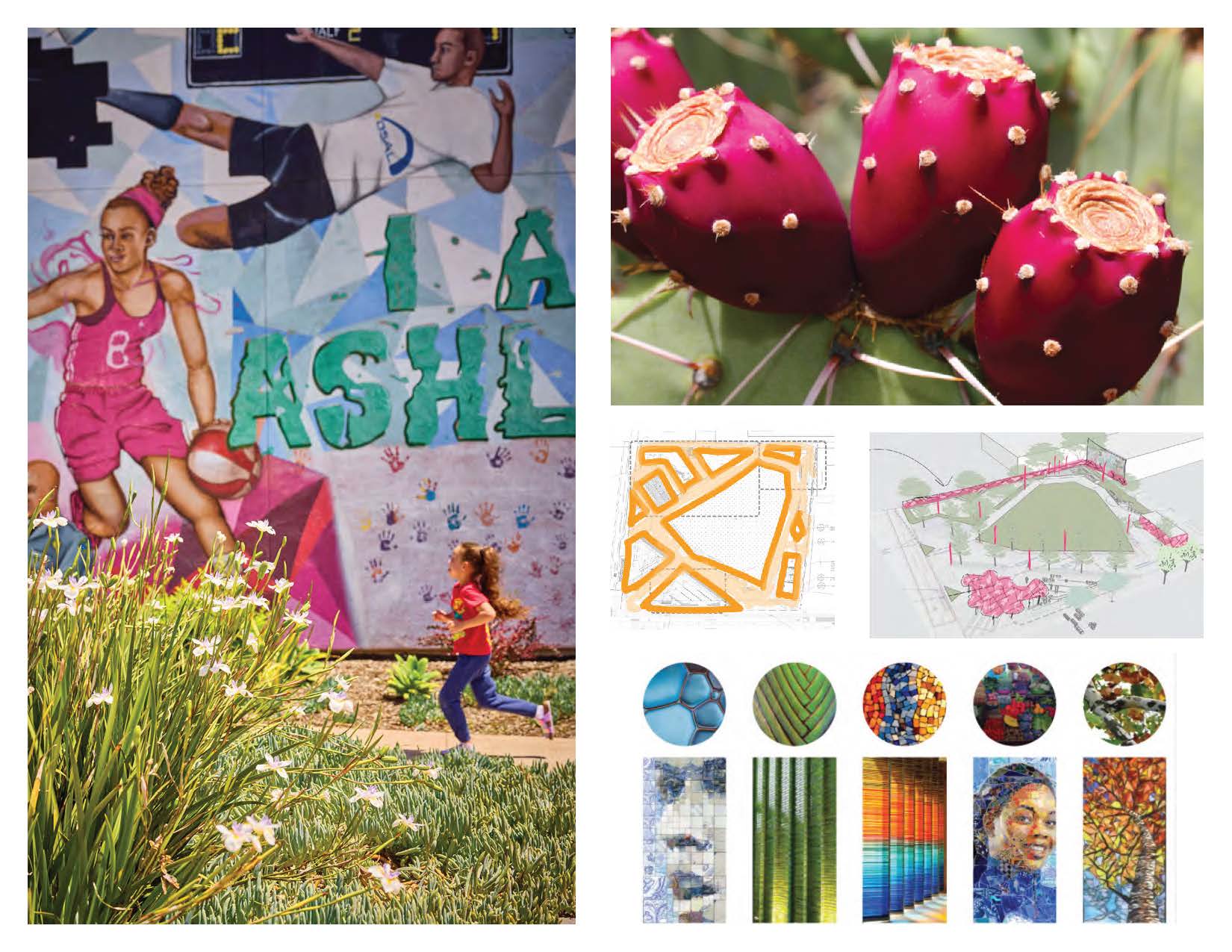
This mood board drew inspiration from a vibrant community context. Culturally significant species such as the prickly pear cactus and the way tile mosaics fit together influenced the site’s color, form, and organization.
©Cesar Rubio Photography

Taking a nod from Mexico City’s Zócalo, Ashland now has a place to celebrate its identity on the main thoroughfare of East 14th Street.
©Cesar Rubio Photography
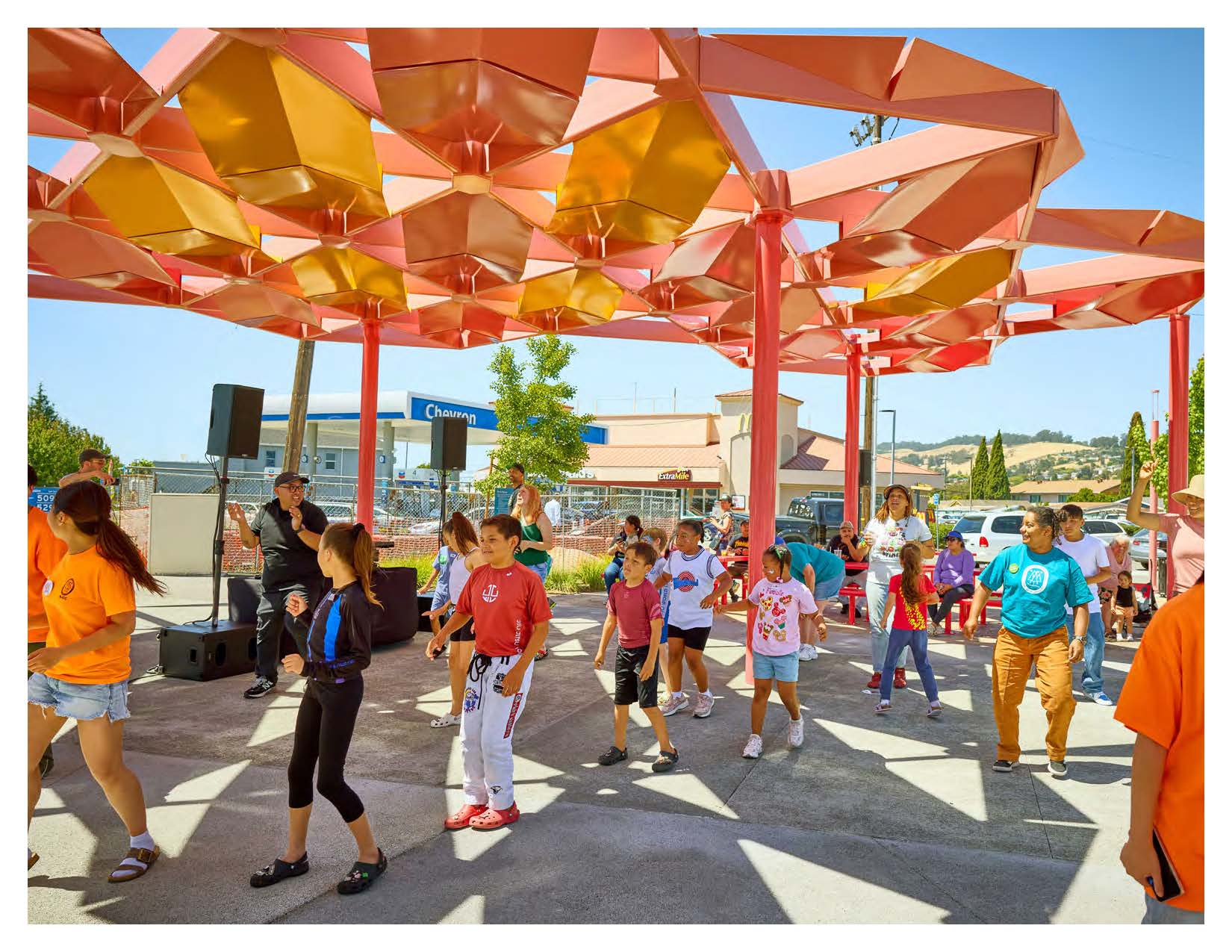
The shade structure acts as the center of the community, accommodating community celebrations and providing critical shade in a community lacking an urban tree canopy.
©Cesar Rubio Photography

A stage anchors the back of the site adjacent to an existing mural, which provided inspiration for the color palette and site design. The stage has become a centerpiece for cultural performances in the community.
©Cesar Rubio Photography

The project helped build capacity among local youth groups, providing training on what landscape architecture is and the basics of creating a planting design. The students then had the opportunity to select native plants and install them as part of a planting day.
©Cesar Rubio Photography

A community vision not only provided a foundation for the site design but was also part of the process that inspired the theme for a recycled tile art mural completed by a local artist.
©Cesar Rubio Photography

The center of the park is a large multi–use lawn, encircled by a walking loop and vibrant planting.
©Cesar Rubio Photography

A 40′ climbing structure offers children a place to escape, enjoy sweeping views of the East Bay Hills, and feel the breeze off the bay.
©Cesar Rubio Photography

A restroom hub was designed as the canvas for a local artist’s recycled tile mural. The restroom was designed to maximize safety, light, and air. A partner programming hub helps serve the district as an office during special events.
©Cesar Rubio Photography

A water feature utilizing fog machines allows children and adults a place to cool off. The site was designed to accommodate farmers‘ markets, where local vendors can sell their goods.
©Cesar Rubio Photography

The stage has become the focal point of the site, where young teens are often seen putting on spontaneous performances.
©Cesar Rubio Photography
Client
HARD - Hayward Area Parks and Recreation District
Project Team
WRT, Lead Landscape Architect
Trust for Public Land, Client Team
WARE + Associates, Architect
CSW, Civil Engineer
HLB, Lighting Designer
RMA, Irrigation Designer
Debra Koppman, Mural Artist
SPEC Play
Project Statement
Ashland is a lively, diverse community nestled in the East Bay, unincorporated, lacking access to green space, and void of a town center. Over five years, a new town center /park went from idea to reality and has now become the heart of Ashland. Inspired by mosaic tiles, the site packs a lot of value into its one-acre lot. A vibrant, diverse planting palette features native, climate-adapted species, with cultural expression reflected in the built environment’s material and color choices. The park was a result of collective authorship, ranging from the planting, art, to the name Zocalo. The park serves as a center for community resilience, providing critical shade, a place to cool off, and an oasis for native habitat. Ashland Zocalo stands as a model for how good design can flourish from an equitable, community-driven process.
Project Description
Located in unincorporated Alameda County, this park provides a refuge on a busy thoroughfare surrounded by major freeways. Over the past twenty years, Ashland has seen a 70% increase in Hispanic/Latino and Asian residents, bringing new cultural traditions and community needs. Despite this growth, the neighborhood lacked a central place to gather, celebrate identity, or enjoy nature.
This project was part of a collective effort between the Landscape Architect, HARD, and the Trust for Public Land. Through an initial community visioning process, the project secured $7 million dollars in state funding the Prop 68 program and quickly moved towards implementation despite a lockdown from a global pandemic. Alignment between key partners and the community, championed by the Landscape Architect, demonstrates the importance and potential of our profession.
Quality of Design and Execution
The park is anchored by a custom shade structure that serves as a vibrant gateway not only to the park but also for the entire Ashland community. The shade structure provides comfort for markets, picnics, and community events, while a variety of trees will further enhance comfort throughout the park. The park’s layout draws inspiration from mosaic tiles set in mortar, balancing diverse programs and green spaces within a compact 1-acre site. This flexible framework allowed for adjustments as constraints arose, all while preserving the overall design vision. The mosaic theme appears across multiple scales, from the play equipment surfacing to a recycled mosaic tile mural at the restroom hub. The restroom and community programming hub were designed with attention to natural light, color, and safety. The planting palette favors native and climate–adapted species, emphasizing vibrancy and cultural expression, reflecting the lively character of many neighborhood front yards. Material choices highlight durability, vibrant colors, and cultural significance, while grading, planting, and hydrology systems are seamlessly integrated to ensure long-term resilience. The result is a cohesive landscape that combines technical excellence with expressive form.
Relationship to Context
Ashland Zócalo is deeply inspired by the neighborhood’s cultural, ecological, and social context. The design responds to the community’s desire for a safe, shaded, and inclusive gathering place that reflects local identity and encourages movement and play. Extensive bilingual engagement shaped every phase of the project—from master planning to construction documentation. Community workshops, including a book-making event and a hands-on park design session, invited residents to articulate their visions for the park. Meetings were conducted primarily in Spanish, with English translation to reflect the community’s primary Spanish-speaking demographic.
Public art became a defining element of the project, which the community wanted to ensure showcased diversity, vibrancy, and connection to our natural world. High school students participated in designing and planting native vegetation, strengthening local stewardship and ecological awareness. The relocation of an existing futsal court was planned through an additional community meeting, demonstrating responsiveness to local concerns and transparency in decision-making.
Relevance and Impact
Ashland Zócalo provides a long-missing civic anchor for a historically underserved community. The project demonstrates how public space can strengthen cultural identity, support local commerce, and foster social cohesion. Its community–driven process offers a replicable model for equitable park development in dense, unincorporated, or infrastructure-constrained neighborhoods. Now open, the park functions as a thriving community hub, offering daily gathering spaces, youth–oriented amenities, and a central plaza for markets and celebrations.
Sustainability and Resilience
Sustainability measures of the park emphasize habitat value, water efficiency, and long-term adaptability. Native and climate-adapted planting reduces irrigation demand while supporting pollinators and urban biodiversity. Permeable surfaces and suspended pavement improve infiltration, reduce stormwater runoff, and provide ample soil space for trees to reach maturity. Shade structures, a diverse tree canopy, and fog areas help mitigate heat-island effects and create comfortable microclimates year-round amid global warming.
Clear Communication of Intent and Outcomes
The project’s intent to create a culturally expressive, ecologically resilient, and community-authored public space is legible in both its design and its process. The built park demonstrates measurable improvements in environmental performance, increased canopy cover, improved stormwater retention, and enhanced habitat value. More importantly, it restores green space in a neighborhood long deprived of it, strengthens local identity, and provides a model for community-driven urban landscape design.